
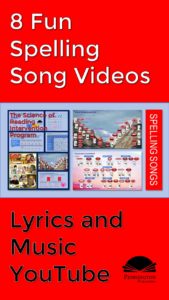
 Introducing the Eight Great Spelling Song audio files and YouTube video links to 8 memorable songs. Help your students (and you) remember and apply the spelling rules in their writing. Turn ’em up! Your kids of all ages will love these. By the way, your upper elementary and middle school students still need spelling instruction. Don’t believe me? Administer my Diagnostic Spelling Assessment and you’ll change your mind. The assessment pinpoints each spelling pattern deficiency.
Break down the components of each spelling rule and elicit other spelling word examples from your students. Look for exceptions to the rules. Even though there are exceptions, it’s much better to start with the rule and works most of the time and adjust to the rule-breakers. If you’re a baseball fan, you know that hitters “look for the fastball and adjust for the curve.”
Yes, these are available in my spelling programs. See promos below. Thanks!
1. The i before e Rule
Usually spell i before e (believe), but spell e before i after a c (receive) and when the letters are pronounced as a long /a/ sound (neighbor).
2. The Final y Rule
Keep the y when adding an ending if the word ends in a vowel, then a y (delay-delayed), or if the ending begins with an i (copy-copying). Change the y to i when adding an ending if the word ends in a consonant, then a y (pretty-prettiest).
3. The Silent e Rule
Drop the e (have-having) at the end of a syllable if the ending begins with a vowel. Keep the e (close-closely) when the ending begins with a consonant, has a soft /c/ or /g/ sound, then an “ous” or “able” (peaceable, gorgeous), or if it ends in “ee”, “oe”, or “ye” (freedom, shoeing, eyeing).
The Final Consonant-e Spelling Rule
4. The Double the Consonant Rule
Double the last consonant, when adding on an ending (permitted), if all three of these conditions are met: 1. the last syllable has the accent (per / mit) 2. the last syllable ends in a vowel, then a consonant (permit). 3. the ending you add begins with a vowel (ed).
5. The Ending “an” or “en” Rule
End a word with “ance”, “ancy”, or “ant” if the root before has a hard /c/ or /g/ sound (vacancy, arrogance) or if the root ends with “ear” or “ure” (clearance, insurance). End a word with “ence”, “ency”, or “ent” if the root before has a soft /c/ or /g/ sound (magnificent, emergency), after “id” (residence), or if the root ends with “ere” (reverence).
6. The “able” or “ible” Rule
End a word with “able” if the root before has a hard /c/ or /g/ sound (despicable, navigable), after a complete root word (teachable), or after a silent e (likeable). End a word with “ible” if the root has a soft /c/ or /g/ sound (reducible, legible), after an “ss” (admissible), or after an incomplete root word (audible).
7. The Ending “ion” Rule
Spell “sion” for the final zyun sound (illusion) or the final shun sound (expulsion, compassion) if after an l or s. Spell “cian” (musician) for a person and “tion” (condition) in most all other cases.
8. The Plurals Rule
Spell plural nouns with an s (dog-dogs), even those that end in y (day-days) or those that end in a vowel, then an o (stereo-stereos). Spell “es” after the sounds of /s/, /x/, /z/, /ch/, or /sh/ (box-boxes) or after a consonant, then an o (potato-potatoes). Change the y to i and add “es” when the word ends in a consonant, then a y (ferry-ferries). Change the “fe” or “lf” ending to “ves” (knife-knives, shelf-shelves).
from The Science of Reading Intervention Program, The Science of Reading Intervention Program, and Differentiated Spelling Instruction (American English and Canadian Versions)


Get the Free Assessment Toolkit
Diagnostic reading and ELA assessments, each with its recording matrix.

From the store · grades 3–8
Differentiated Spelling Instruction
Weekly spelling sorts, pattern tests and remedial worksheets matched to every item on the Diagnostic Spelling Assessment. $49.99 per grade, licensed per teacher.
Questions teachers ask
Which grade’s spelling diagnostic should I use?
There is only one. The Diagnostic Spelling Assessment covers the spelling patterns of grades 1 through 7 and is the same test in every grade-level program, so it can be given in any grade from 4 up. A Canadian English version is included as well.
Do I have to buy anything to use the assessments?
No. Every diagnostic assessment on this site is free. Enter your email on the Free Assessment Toolkit page and the diagnostic assessments arrive as downloads, each with its recording matrix.
How are the programs licensed?
Every program is a digital download licensed for one teacher. School and district purchase orders are accepted through the store.

Mark Pennington, M.A. Reading Specialist
Thirty-six years teaching ELA and reading, elementary through community college, plus district reading specialist. He wrote every program on this site.
More about Mark →
1 comment