
I used to feel a bit guilty about doing test prep although the WIDA, ELPAC, ELPA 21, TELPAS websites all suggest doing their test practice samples prior to ELPA administration. However, the more I think about what English language development is all about, the more I see the dual role of test prep and instruction as complimentary.
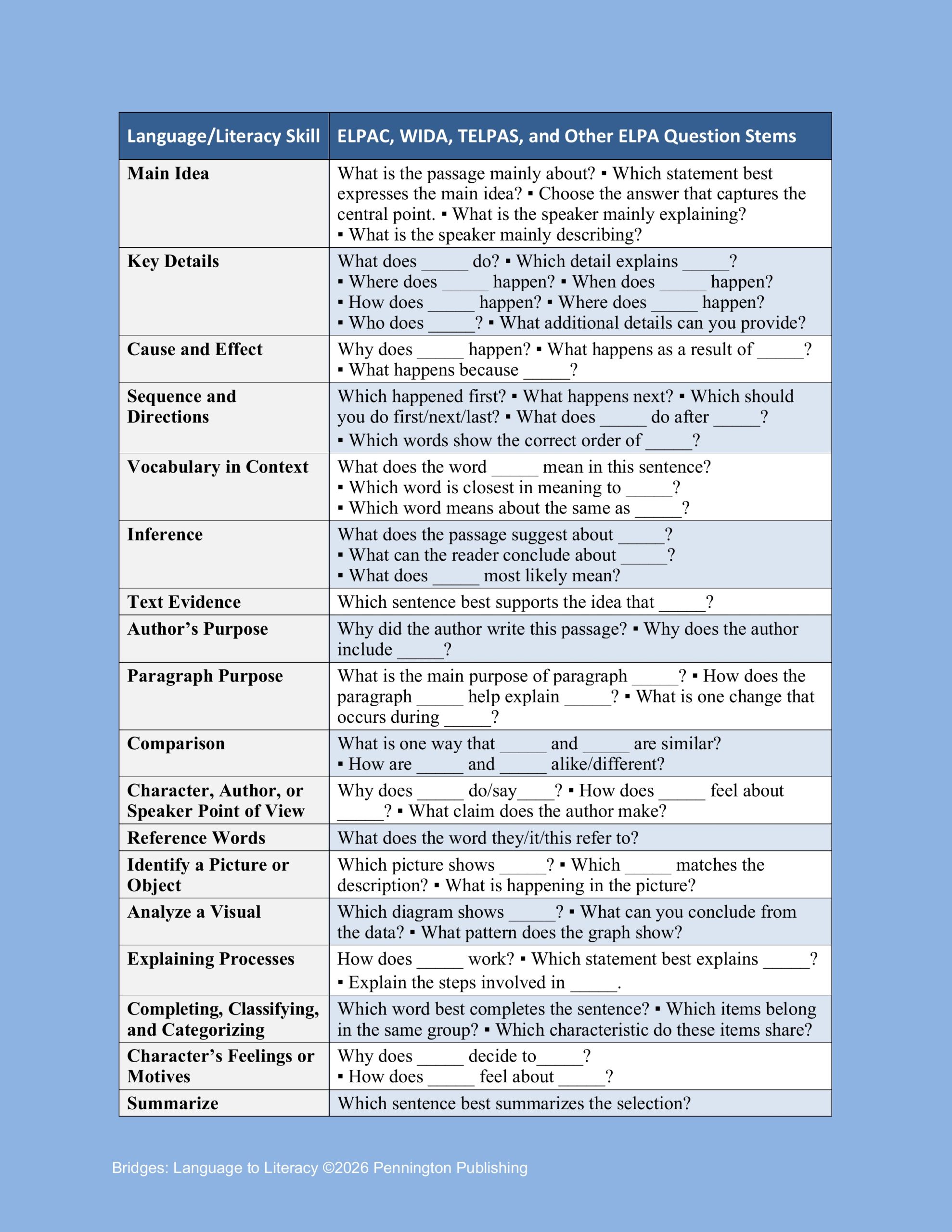
I know that students often fail to do as well as they could on our assessments because they are unfamiliar with the question stem wording, or they don’t understand some of the question stem vocabulary e.g., passage, text, supports, purpose. Plus, students often read into the question stem something that’s not quite there. Or they focus on only one part of the question stem.
It seems to me that in English language development, we are teaching students how language functions. My take is that familiarization with the assessment question stems will help your students perform to the level they are capable of achieving on their WIDA, ELPAC, ELPA21, and TELPAS assessments.
I’ve searched the major English proficiency assessment websites and compiled a one-pager on common ELPA question stems. I posted it on all the ML/EL FB groups. Hundreds of teachers asked for copies, so I thought I’d better post it here on my Pennington Publishing blog and provide links on the FB sites.
As I studied the question stems, I realized it’s no wonder that our students aren’t able to accurately “show what they know” on our proficiency assessments. Sometimes only one unknown noun or verb in the directions can completely derail a student’s response, especially in the reading and writing sections. So, I think you might find this list of academic nouns and verbs (with simple definitions) that appear in the ELPA test directions to be a helpful complement to the ELPA Question Stems.
“The ELPA Question Stems and ELPA Nouns and Verbs look like great resources. So how do we use them?”
Great question. I’ve brainstormed a few ideas and would love to see more in the comments.
- The purpose, vocabulary, and syntax of the question stems will provide you and your students with a language of analytical discussion in your classroom. I would laminate and keep copies of the question stems and academic nouns and verbs one-pagers handy for oral language practice, literary analysis of reading passages, etc. For my students, I always reward their use of the ELPA academic nouns and verbs in class discussions.
- Use the question stems as sentence frames for oral language practice and writing.
- Teach students how to change the question stems to statements. It’s also the R in RACE: Restate the question, Answer, Cite evidence, and Explain Example: What is the passage mainly about? The passage is mainly about _____.
- Teach syntax revision. Example: Let’s start our statement with the adverb, “mainly.” Mainly, the passage is about _____.
- Use the ELPA nouns and verbs one-pager to prompt sentence expansion: Who? What? Where? When? Why? How? Example: To summarize, the passage is mainly about _____ and the evidence others use to support their points. Bingo! Your students just used four of the academic nouns and verbs used on the ELPAs.
- Pass along copies to your content teachers to use with their/your students.
- For your ELP Levels ≤ 3.0, I would add pictures and/or graphics to the academic nouns and verbs.
- Other ideas? Please keep the brainstorming going in the comments.
FREE Downloads
ELPA Language and Literacy Question Stems
Grades K-5 ELPA Nouns and Verbs
Grades 6-12 ELPA Nouns and Verbs
*****
Now, if you’re interested in upping your syntax game to improve reading comprehension and writing sophistication, I heartily recommend my own program: ELD Syntax in Reading and Writing. Ideal for the grammatically challenged! Needed for all ML/EL students at all levels.
ELD Syntax in Reading and Writing will help your students learn the function of syntactic tools in reading and writing at the sentence level. These lessons teach how challenging sentences are constructed. The program is function-focused, that is, no unnecessary grammar jargon, no endless editing exercises, no drill and kill worksheets, etc. Think practical easy-to-teach lessons ala the research in Syntax Matters by William Van Cleave and Artful Sentences by Virginia Tufte. Preview the whole program HERE.
Get the Free Assessment Toolkit
Diagnostic reading and ELA assessments, each with its recording matrix.

From the store · grades 4–8
Teaching Grammar, Usage and Mechanics
Grade-level lessons, remedial worksheets keyed to the diagnostic assessments, and unit tests. $49.99 per grade, licensed per teacher.
Questions teachers ask
Which grammar assessments are free?
The grammar and usage assessment and the mechanics assessment are both in the free toolkit. Each comes with a recording matrix that shows which conventions a student has and has not mastered, so instruction can be targeted instead of whole-class.
Do I have to buy anything to use the assessments?
No. Every diagnostic assessment on this site is free. Enter your email on the Free Assessment Toolkit page and the diagnostic assessments arrive as downloads, each with its recording matrix.
How are the programs licensed?
Every program is a digital download licensed for one teacher. School and district purchase orders are accepted through the store.

Mark Pennington, M.A. Reading Specialist
Thirty-six years teaching ELA and reading, elementary through community college, plus district reading specialist. He wrote every program on this site.
More about Mark →