Published Jan 24, 2019 Updated Aug 25, 2026 2 min read
Avoiding Parentheses
Jesse complained, “Ms. Sherril banned me from using parentheses in my essays.”
“They can get annoying,” said Ryan.
“Okay, I’ll just use dashes or brackets instead.”
“Uh, no. Pretty soon you’ll be banned from writing anything.”
Definition and Examples
An appositive is a noun, pronoun, or noun phrase that identifies or explains another noun or pronoun before or after it. If the appositive is nonessential to the meaning of the sentence, parentheses (or commas) are used to signal and separate this identification or explanation. The appositive could be removed without changing the basic meaning of the sentence. Examples: An actress, Marta, knew how to project. Jane (the girl with red hair) acted childishly. If the appositive is essential to the meaning of the sentence, no punctuation is used. Example: The U.S. president Ronald Reagan was known as “The Great Communicator.”
Read the rule.
Avoid using unnecessary appositives. When you must use an appositive in an essay, use commas, rather than parentheses, to set apart the appositive from the noun or pronoun it modifies.
Practice
Write the following sentences and [bracket] the appositives and their punctuation.
Nancy (the pharmacist) advised my mom to buy the over-the-counter brand.
Mitchell was talking to Wanda, Lisa’s little sister.
By 1786, ten years after the writing of the Declaration of Independence, England was once again our largest trading partner including exports (chiefly cotton) and imports (mainly textiles).
My sister’s bicycle (a bright green BMX) was stolen off the porch (where she left it).
The women, Ms. Mears, paid for our trip (the flight, car rental, and hotel).
Revise the sentence, eliminating the appositive.
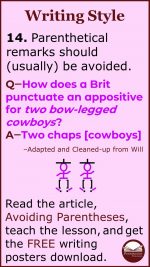
Parenthetical remarks should (usually) be avoided.
Answers
Nancy [(the pharmacist)] advised my mom to buy the over-the-counter brand.
Mitchell was talking to Wanda[, Lisa’s little sister].
By 1786[, ten years after the writing of the Declaration of Independence,] England was once again our largest trading partner including exports [(chiefly cotton)] and imports [(mainly textiles)].
My sister’s bicycle [(a bright green BMX)] was stolen off the porch [(where she left it)].
The women[, Ms. Mears,] paid for our trip [(the flight, car rental, and hotel)].
Teaching Essay Strategies | Step by Step Worksheets, Skills, and 8 Process Essays For more essay rules and practice, check out the author’s TEACHING ESSAYS BUNDLE.This curriculum includes 42 essay strategy worksheets corresponding to teach the Common Core State Writing Standards,8 on-demandwriting fluencies, 8 writing process essays (4 argumentative and 4 informative/explanatory), 64 sentence revisionand 64 rhetorical stance“openers,” writing posters, and helpful editing resources.
Differentiate your essay instruction inthis comprehensive writing curriculum with remedial writing worksheets, including sentence structure, grammar, thesis statements, errors in reasoning, and transitions.
Plus, get an e-comment bank of 438 prescriptive writing responses with an link to insert into Microsoft Word® for easy e-grading (works great with Google Docs),
Download the following 24 FREE Writing Style Posters to help your students learn the essay rules. Each has a funny or ironic statement (akin to “Let’s eat Grandma) to teach the memorable rule.
Get the Writing Style Posters FREE Resource:
Get the Free Assessment Toolkit
Diagnostic reading and ELA assessments, each with its recording matrix.
From the store · grades 4–8
Teaching Grammar, Usage and Mechanics
Grade-level lessons, remedial worksheets keyed to the diagnostic assessments, and unit tests. $49.99 per grade, licensed per teacher.
The grammar and usage assessment and the mechanics assessment are both in the free toolkit. Each comes with a recording matrix that shows which conventions a student has and has not mastered, so instruction can be targeted instead of whole-class.
Do I have to buy anything to use the assessments?
No. Every diagnostic assessment on this site is free. Enter your email on the Free Assessment Toolkit page and the diagnostic assessments arrive as downloads, each with its recording matrix.
How are the programs licensed?
Every program is a digital download licensed for one teacher. School and district purchase orders are accepted through the store.
Mark Pennington, M.A. Reading Specialist
Thirty-six years teaching ELA and reading, elementary through community college, plus district reading specialist. He wrote every program on this site.