
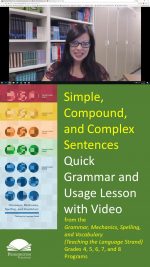
Simple, Complex, and Compound Sentences
Play the quick video lesson HERE and click the upper left back arrow to return to this lesson.
Common Core Language Standard 1
Sentence variety is so key to learning how to write well. Most people don’t order vanilla ice cream every time they visit an ice cream store. Variety is a good thing both in ice cream and in writing. Writing too many simple sentences, complex sentences, or compound sentences in a row produces extremely boring writing. One good generalization is to avoid using any of these sentences more than twice in a row. Three in a row gets almost unreadable. Mix it up and your reader will appreciate your efforts.
Today’s grammar and usage lesson is on simple, compound, and complex sentences. Remember that a sentence must have a subject and predicate, but there are many forms of sentence construction.
Now let’s read the grammar and usage lesson and study the examples.
A simple sentence includes a subject and a simple predicate. A subject is the do-er of the sentence and is usually found near the beginning of the sentence unless the sentence is a question. A simple predicate is the action… or what the do-er does. A compound sentence includes two independent clauses. A complex sentence includes an independent clause and a dependent clause.
Now circle or highlight what is right and revise what is wrong according to grammar and usage lesson.
Practice: After I took her home, then we drove around, but before that I went to the mall.
Let’s check the Practice Answers.
Grammar and Usage Practice Answers: After I took her home, my friends and I went to the mall, and then we drove around.
Now let’s apply what we have learned.
Writing Application: Write your own compound and complex sentences.
*****

Teaching Grammar, Usage, and Mechanics (Grades 4, 5, 6, 7, 8, and High School) are full-year, traditional, grade-level grammar, usage, and mechanics programs with plenty of remedial practice to help students catch up while they keep up with grade-level standards. Twice-per-week, 30-minute, no prep lessons in print or interactive Google slides with a fun secret agent theme. Simple sentence diagrams, mentor texts, video lessons, sentence dictations. Plenty of practice in the writing context. Includes biweekly tests and a final exam.
Grammar, Usage, and Mechanics Interactive Notebook (Grades 4‒8) is a full-year, no prep interactive notebook without all the mess. Twice-per-week, 30-minute, no prep grammar, usage, and mechanics lessons, formatted in Cornell Notes with cartoon response, writing application, 3D graphic organizers (easy cut and paste foldables), and great resource links. No need to create a teacher INB for student make-up work—it’s done for you! Plus, get remedial worksheets, biweekly tests, and a final exam.
Syntax in Reading and Writing is a function-based, sentence-level syntax program, designed to build reading comprehension and increase writing sophistication. The 18 parts of speech, phrases, and clauses lessons are each leveled from basic (elementary) to advanced (middle and high school) and feature 5 lesson components (10–15 minutes each): 1. Learn It! 2. Identify It! 3. Explain It! (analysis of challenging sentences) 4. Revise It! (kernel sentences, sentence expansion, syntactic manipulation) 5. Create It! (Short writing application with the syntactic focus in different genre).
Get the Diagnostic Grammar, Usage, and Mechanics Assessments, Matrix, and Final Exam FREE Resource:

Get the Free Assessment Toolkit
Diagnostic reading and ELA assessments, each with its recording matrix.

From the store · grades 4–8
Teaching Grammar, Usage and Mechanics
Grade-level lessons, remedial worksheets keyed to the diagnostic assessments, and unit tests. $49.99 per grade, licensed per teacher.
Questions teachers ask
Which grammar assessments are free?
The grammar and usage assessment and the mechanics assessment are both in the free toolkit. Each comes with a recording matrix that shows which conventions a student has and has not mastered, so instruction can be targeted instead of whole-class.
Do I have to buy anything to use the assessments?
No. Every diagnostic assessment on this site is free. Enter your email on the Free Assessment Toolkit page and the diagnostic assessments arrive as downloads, each with its recording matrix.
How are the programs licensed?
Every program is a digital download licensed for one teacher. School and district purchase orders are accepted through the store.

Mark Pennington, M.A. Reading Specialist
Thirty-six years teaching ELA and reading, elementary through community college, plus district reading specialist. He wrote every program on this site.
More about Mark →