Literacy knowledge refers to how language and text are organized to communicate.
“We have long known that students benefit from instruction in common structures and elements of narrative or story text (e.g., identifying characters, setting, goal, problem, events, resolution, and theme; e.g., Fitzgerald & Spiegel, 1983). With respect to informational text, meta-analyses (quantitative studies of many studies) have also documented positive impacts (Hebert, Bohaty, & Nelson, 2016; Pyle et al., 2017).”
Nell K. Duke, Alessandra E. Ward, P. David Pearson, 2021
Children begin acquiring literacy knowledge even before their first “Once upon a time…” story. Children from literate households learn a wealth of background literacy knowledge even before they begin to read. Through print and media, children are exposed to story structure, character development, and the elements of plot. Moreover, students experience different kinds of narratives, such as fairy tales, poems, and songs—many of which include sensory/descriptive writing.
In addition to narrative and sensory descriptive genre, children also learn expository structures and their components. For example, when a parent tells a child the agenda for the day such as “First, we will finish our breakfast; next, you will brush your teeth; afterwards, you will put on your backpack…,” the child learn sequential organization and key sequence and number transitions.
Because older students in reading intervention classes often have missed out on many pre-reading learning experiences, the reading intervention teacher has gaps in literacy background knowledge to fill to help their students access prior knowledge when reading different types of text.
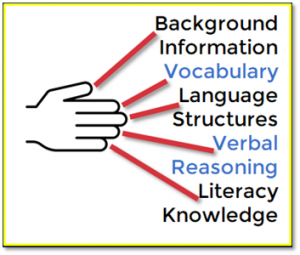
Language Comprehension Literacy Knowledge is one of seven key components in the upper strand of Scarborough’s Reading Rope. The 47 Literacy Knowledge lessons, included in The Science of Reading Intervention Program: Language Comprehension, serve as a crash course in text structures, literary elements, sentence functions, and genres for your students. Students will learn to identify (read) and apply (write] narrative and sensory/descriptive text structures and literary elements. Students will also learn to identify (read) and apply (write] expository and argumentative text structures and sentence functions in a wide variety of genre to improve reading comprehension. Each lesson takes about 35 minutes to complete.
The narrative and sensory/descriptive lessons are provided first, followed by the expository and argumentative lessons, but the teacher may decide to pick and choose. Some of the lessons build upon previous lessons, but others are stand-alone.
The teacher introduces each lesson; students complete guided practice with correction and review; and students complete the lesson with independent practice, which serves as the formative assessment. Answers included.
*****

- Background Knowledge: Mentor text bell ringers
- Vocabulary Worksheets: Academic language, Greek and Latin morphology, figures of speech, connotations, multiple meaning words with the Diagnostic Academic Language Placement Assessment.
- Syntax in Reading
- Reading Comprehension: Strategies and expository animal articles, composed in tiered grades 1-7 levels with inferential questions
- Literacy Knowledge: Narrative and expository genre and text structure
- Greek and Latin Morphology: Guided lessons with anchor words
- Executive Function and Study Skills
No prep, no outside of class correction. Easy to teach. Written by a teacher (MA reading specialist and ELA teacher) for teachers and their students to improve struggling readers’ reading as quickly as possible. Preview the entire program.
Get the Free Assessment Toolkit
Diagnostic reading and ELA assessments, each with its recording matrix.

From the store · grades 4–adult
Reading Fluency and Comprehension Toolkit
Modeled readings at three speeds with comprehension questions in the margins, plus the fluency assessment. $39.99, licensed per teacher.
Questions teachers ask
Which reading assessments are free?
Phonics, phonemic awareness, reading fluency and literacy knowledge are all in the free toolkit, each with a recording matrix for progress monitoring.
Do I have to buy anything to use the assessments?
No. Every diagnostic assessment on this site is free. Enter your email on the Free Assessment Toolkit page and the diagnostic assessments arrive as downloads, each with its recording matrix.
How are the programs licensed?
Every program is a digital download licensed for one teacher. School and district purchase orders are accepted through the store.

Mark Pennington, M.A. Reading Specialist
Thirty-six years teaching ELA and reading, elementary through community college, plus district reading specialist. He wrote every program on this site.
More about Mark →