
Simply put, any language’s grammar is the attempt to organize and systematize how its oral and written language works. A grammar provides a common language of instruction. It helps us understand how words function and how words are put together in a sentence to communicate effectively. It also provides rules for proper word choice, inflections, and usage.
Attempts to graphically represent a grammar are usually called diagramming. Most grammatical diagrams are designed to represent the sentence, since the sentence, by definition, is the
shortest representation of a complete thought. Alonzo Reed and Brainerd Kellogg first published the graphic depictions that we call sentence diagrams in their book, Higher Lessons in English, in 1877. http://en.wikipedia.org/wiki/Sentence_diagram Linguists have always used sentence diagramming, albeit with different versions. For example, Noam Chomsky developed his own X-bar diagramming system in 1970. However, the Reed-Kellogg system has remained the most popular method because of its simplicity.
Why Teach Sentence Diagramming?
Proponents argue that sentence diagramming is a useful visual tool that allows teachers and students to identify the different parts of sentences, understand how these parts function, and see how these parts relate to other parts of the sentence. Most students find that the visual image helps them better understand and remember the parts of a sentence, grammatical terms, and the rules of grammar. Sentence diagrams make the abstract components of English grammar concrete for English speakers and writers. With a bit of practice, writers can use diagramming to diagnose their own grammatical errors and fix them.
Why Not Teach Sentence Diagramming?
Opponents argue that constructing sentence diagrams is not authentic writing; it is analysis. Understanding the parts of sentences and how they relate to one another does not necessarily mean that a student can apply this understanding to construct meaningful sentences. Correct sentences are not the same as coherent sentences. Furthermore, sentence diagramming does not go beyond the sentence level and so does not deal with connected thought, that is the paragraph level, or by extension, a unified essay. Lastly, any instructional practice is reductive—it takes away instructional time. Students learning to write benefit more from authentic writing practice, than from sentence diagramming analysis.
Does Sentence Diagramming Make Sense?
Effective writing instruction melds both analysis and practice. Students need the deductive apply-the-components/rules-of-grammar approach and the inductive practice-the-meaningful-communication of ideas-with-feedback approach to become effective writers. Some sentence diagramming does make sense: not too much to take over a writing program, but just enough to do its job. I advocate more recognition practice and less application practice. In other words, providing a sentence diagram with one or two missing words, say the direct and indirect objects, and having students identify and place those two missing parts of the sentence, achieves the instructional objective just as well as taking the time needed for students to construct the whole sentence. If you’re studying a leaf, you don’t have to draw the whole tree.
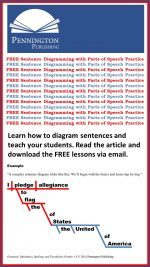
Find out How to Teach Sentence Diagramming in three 10-minute lessons. Sentence diagramming can be an effective instructional ingredient in a comprehensive standards-based grammar curriculum.
*****

Teaching Grammar, Usage, and Mechanics (Grades 4, 5, 6, 7, 8, and High School) are full-year, traditional, grade-level grammar, usage, and mechanics programs with plenty of remedial practice to help students catch up while they keep up with grade-level standards. Twice-per-week, 30-minute, no prep lessons in print or interactive Google slides with a fun secret agent theme. Simple sentence diagrams, mentor texts, video lessons, sentence dictations. Plenty of practice in the writing context. Includes biweekly tests and a final exam.
Grammar, Usage, and Mechanics Interactive Notebook (Grades 4‒8) is a full-year, no prep interactive notebook without all the mess. Twice-per-week, 30-minute, no prep grammar, usage, and mechanics lessons, formatted in Cornell Notes with cartoon response, writing application, 3D graphic organizers (easy cut and paste foldables), and great resource links. No need to create a teacher INB for student make-up work—it’s done for you! Plus, get remedial worksheets, biweekly tests, and a final exam.
Syntax in Reading and Writing is a function-based, sentence-level syntax program, designed to build reading comprehension and increase writing sophistication. The 18 parts of speech, phrases, and clauses lessons are each leveled from basic (elementary) to advanced (middle and high school) and feature 5 lesson components (10–15 minutes each): 1. Learn It! 2. Identify It! 3. Explain It! (analysis of challenging sentences) 4. Revise It! (kernel sentences, sentence expansion, syntactic manipulation) 5. Create It! (Short writing application with the syntactic focus in different genre).
Get the Diagnostic Grammar, Usage, and Mechanics Assessments, Matrix, and Final Exam FREE Resource:

Want to try sentence diagramming absolutely FREE? Get lessons sent to your email:
Get the Sentence Diagramming and Parts of Speech Practice FREE Resource:
Get the Free Assessment Toolkit
Diagnostic reading and ELA assessments, each with its recording matrix.

From the store · grades 4–8
Teaching Grammar, Usage and Mechanics
Grade-level lessons, remedial worksheets keyed to the diagnostic assessments, and unit tests. $49.99 per grade, licensed per teacher.
Questions teachers ask
Which grammar assessments are free?
The grammar and usage assessment and the mechanics assessment are both in the free toolkit. Each comes with a recording matrix that shows which conventions a student has and has not mastered, so instruction can be targeted instead of whole-class.
Do I have to buy anything to use the assessments?
No. Every diagnostic assessment on this site is free. Enter your email on the Free Assessment Toolkit page and the diagnostic assessments arrive as downloads, each with its recording matrix.
How are the programs licensed?
Every program is a digital download licensed for one teacher. School and district purchase orders are accepted through the store.

Mark Pennington, M.A. Reading Specialist
Thirty-six years teaching ELA and reading, elementary through community college, plus district reading specialist. He wrote every program on this site.
More about Mark →