Teachers should teach the sound-spelling system as part of a balanced spelling program. To determine the individual needs of your students, teachers need the comprehensive Diagnostic Spelling Assessment to diagnose students and plan effective instruction.
As I previously mentioned, each of the six posts will begin with a brief reflection about the instructional spelling component, follow with a rationale for teaching that component, and finish with some free instructional spelling resources. The components of each of the six posts are as follows:
1. Diagnostic Assessment 2. Sound-Spellings 3. Spelling Rules
4. Spelling Lists and Tests 5. Spelling Practice 6. Integrated Spelling and Vocabulary.
This week we explore how to teach the spelling rules.
Reflection
- I know the key eight conventional spelling rules that work most all of the times.
- I have an instructional plan in place to teach these spelling rules.
- I have formative assessments in place to analyze their progress.
Rationale
Just because the English sound-spelling system works in only about 50% of spellings does not mean that there are not predictable spelling patterns to increase that percentage of spelling predictability and accuracy. Although the sound-spelling patterns are the first line of defense, the conventional spelling rules that work most all of the time are a necessary back-up.
Spelling Resources
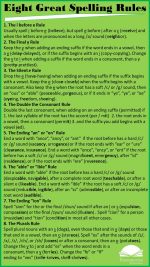
Here are the Eight Great Spelling Rules with links to memorable MP3 songs and raps to help your students (and you) remember them. TURN THEM UP!
1. The i before e Rule
Usually spell i before e (believe), but spell e before i after a c (receive) and when the letters are pronounced as a long /a/ sound (neighbor).
2. The Final y Rule
Keep the y when adding an ending if the word ends in a vowel, then a y (delay-delayed), or if the ending begins with an i (copy-copying). Change the y to i when adding an ending if the word ends in a consonant, then a y (pretty-prettiest).
3. The Silent e Rule
Drop the e (have-having) at the end of a syllable if the ending begins with a vowel. Keep the e (close-closely) when the ending begins with a consonant, has a soft /c/ or /g/ sound, then an “ous” or “able” (peaceable, gorgeous), or if it ends in “ee”, “oe”, or “ye” (freedom, shoeing, eyeing).
4. The Double the Consonant Rule
Double the last consonant, when adding on an ending (permitted), if all three of these conditions are met: 1. the last syllable has the accent (per / mit) 2. the last syllable ends in a vowel, then a consonant (permit). 3. the ending you add begins with a vowel (ed).
5. The Ending “an” or “en” Rule
End a word with “ance”, “ancy”, or “ant” if the root before has a hard /c/ or /g/ sound (vacancy, arrogance) or if the root ends with “ear” or “ure” (clearance, insurance). End a word with “ence”, “ency”, or “ent” if the root before has a soft /c/ or /g/ sound (magnificent, emergency), after “id” (residence), or if the root ends with “ere” (reverence).
6. The “able” or “ible” Rule
End a word with “able” if the root before has a hard /c/ or /g/ sound (despicable, navigable), after a complete root word (teachable), or after a silent e (likeable). End a word with “ible” if the root has a soft /c/ or /g/ sound (reducible, legible), after an “ss” (admissible), or after an incomplete root word (audible).
7. The Ending “ion” Rule
Spell “sion” for the final zyun sound (illusion) or the final shun sound (expulsion, compassion) if after an l or s. Spell “cian” (musician) for a person and “tion” (condition) in most all other cases.
8. The Plurals Rule
Spell plural nouns with an s (dog-dogs), even those that end in y (day-days) or those that end in a vowel, then an o (stereo-stereos). Spell “es” after the sounds of /s/, /x/, /z/, /ch/, or /sh/ (box-boxes) or after a consonant, then an o (potato-potatoes). Change the y to i and add “es” when the word ends in a consonant, then a y (ferry-ferries). Change the “fe” or “lf” ending to “ves” (knife-knives, shelf-shelves).
A Model Grades 3-8 Spelling Scope and Sequence

Preview the Grades 3-8 Spelling Scope and Sequence tied to the author’s comprehensive grades 3-8 Language Strand programs. The instructional scope and sequence includes grammar, usage, mechanics, spelling, and vocabulary. Teachers and district personnel are authorized to print and share this planning tool, with proper credit and/or citation. Why reinvent the wheel? Also check out my articles on Grammar Scope and Sequence, Mechanics Scope and Sequence, and Vocabulary Scope and Sequence.
FREE DOWNLOAD TO ASSESS THE QUALITY OF PENNINGTON PUBLISHING AMERICAN ENGLISH AND CANADIAN ENGLISH SPELLING PROGRAMS. Check out these grades 3-8 programs HERE. Administer my FREE comprehensive Diagnostic Spelling Assessment with audio file and recording matrix. It has 102 words (I did say comprehensive) and covers all common spelling patterns and conventional spelling rules. It only takes 22 minutes and includes an audio file with test administration instructions. Once you see the gaps in your students’ spelling patterns, you’re going to want to fill those gaps.
Get the Diagnostic Spelling Assessment, Matrix, and Sample Lessons FREE Resource:

Get the Free Assessment Toolkit
Diagnostic reading and ELA assessments, each with its recording matrix.

From the store · grades 4–8
Comprehensive Vocabulary
56 vocabulary lessons with study guides, biweekly unit tests and a final exam — built for word-study rotations. $39.99 per grade, licensed per teacher.
Questions teachers ask
Can the programs be used in centers rather than whole class?
Yes. The remedial worksheets are keyed one-to-one to items on the diagnostic assessments, so students can work on their own gaps independently while the rest of the class rotates.
Do I have to buy anything to use the assessments?
No. Every diagnostic assessment on this site is free. Enter your email on the Free Assessment Toolkit page and the diagnostic assessments arrive as downloads, each with its recording matrix.
How are the programs licensed?
Every program is a digital download licensed for one teacher. School and district purchase orders are accepted through the store.

Mark Pennington, M.A. Reading Specialist
Thirty-six years teaching ELA and reading, elementary through community college, plus district reading specialist. He wrote every program on this site.
More about Mark →
Your books look like a valuable resource to teachers especially those in higher grades.
As I have tutored children who are struggling in school for the last 36 years, I have seen what a great help music can be in memorizing rules. Your using raps and songs to help children remember spelling rules is wonderful!
Hi Mark, Nice article. We appreciated your comments on our posts and wanted to return the favor. Here are some fun activities that parents can do with their children as Warm Ups for the start of school http://www.creativelearningsource.blogspot.com
Hi there mark – i have a question that im hoping you could answer.
Why is it that we say 1 house and many houses. but 1 mouse and many
MICE? What is this rule? i would like to be able to understand . why are there mouses? or Hice?
Hoping for a good reply,
thanks
mary
Sorry to disappoint. Plurals do have exceptions and spelling irregularities are many.
Sorry, I don’t. Good idea, though.
Cause that is how it should be.
If you pronounce plural : mouse – mouses it gives harder impact / or unnecessary pressure to you articulation. It is because English letters / sound and words are coined to make communication flow easily.
I was unable to download:
FREE DOWNLOAD TO ASSESS THE QUALITY OF PENNINGTON PUBLISHING SPELLING RESOURCES.
Would you please send me the information?
Thank you!
Ms. Lany Herrera
4th Grade Teacher
lanyherrera7@gmail.com
Thank you
Fixed. My apologies.
Often the differences in words are due to origin
Mouse = Sanskrit
House = German
Not all languages true same alphabet
Marvelous site to help teachers with their everyday work.
Thanks so much.
Hi, I was wondering if there was a link to the green 8 great spelling rules document? I’d love to be able to access it for my kids. Thank you
https://blog.penningtonpublishing.com/how-to-teach-spelling-part-iii/