Archive

Posts Tagged ‘essay rules’

Split Infinitives

To Split Infinitives

Split Infinitives

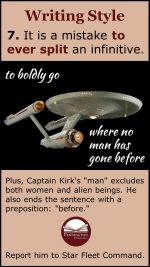
“Hey, James, Mr. Pomeroy is wrong about splitting infinitives! To occasionally split an infinitive is fine. Captain Kirk splits an infinitive when he states the mission of the Starship Enterprise at the beginning of each Star Trek episode.

“You’re talking about ‘to boldly go where no man has gone before’ where ‘boldly’ is placed between the two words of the infinitive, to go. That’s not Captain Kirk’s only grammatical mistake. Saying ‘man’ excludes both women and alien beings. He also ends the sentence with a preposition: ‘before.’ We should report him to Star Fleet Command.”
Definition and Examples

An infinitive usually consists of to plus the base form of the verb. Examples: to run, to hide

This infinitive form does not indicate past, present, or future verb tense and does not connect to the subject of the sentence. Example: Joseph liked to go to the mall. “Joseph” is the subject and “liked” is the predicate. The infinitive “to go” serves as a modifier of the verb, “liked,” but does not signal past, present, or future action.

A split infinitive occurs when the speaker or writer inserts one or more words between the to and the base form of the verb. Examples: To never walk is his goal. She wants to someday soon ski.

Read the rules.

Writing and Reading Syntax

Syntax in Reading and Writing

  • Splitting infinitives is fine in casual conversation and in informal writing; however, avoid adding more than one word between the to and the base form of the verb.
  • Avoid using split infinitives in formal writing, such as in essays.

Practice

Write the following sentences and [bracket] the split infinitives in the following sentences.

  1. To seriously ask the question of the comic was his choice, alone.
  2. Zoe wished to always be considered the expert, and she hoped to soon achieve her goal.
  3. Why do you need to completely and totally abandon the plan to somehow defend your honor?
  4. I did not expect to have to willingly go when I would have rather stayed at home.
  5. Listening to music makes me happy to be alive and to often visit my friends.

Revise the split infinitive.

It is a mistake to ever split an infinitive.

Answers

  1. [To seriously ask] the question of the comic was his choice, alone.
  2. Zoe wished [to always be] considered the expert, and she hoped [to soon achieve] her goal.
  3. Why do you need [to completely and totally abandon] the plan [to somehow defend] your honor?
  4. I did not expect to have [to willingly go] when I would have rather stayed at home.
  5. Listening to music makes me happy to be alive and [to often visit my friends].

Pennington Publishing's TEACHING ESSAYS BUNDLE

TEACHING ESSAYS BUNDLE

For more essay rules and practice, check out the author’s TEACHING ESSAYS BUNDLE. This curriculum includes 42 essay strategy worksheets corresponding to teach the Common Core State Writing Standards, 8 on-demand writing fluencies, 8 writing process essays (4 argumentative and 4 informative/explanatory), 64  sentence revision and 64 rhetorical stance “openers,” writing posters, and helpful editing resources. 

Differentiate your essay instruction in this comprehensive writing curriculum with remedial writing worksheets, including sentence structure, grammar, thesis statements, errors in reasoning, and transitions.

Plus, get an e-comment bank of 438 prescriptive writing responses with an link to insert into Microsoft Word® for easy e-grading (works great with Google Docs),

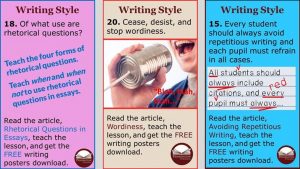
Download the following 24 FREE Writing Style Posters to help your students learn the essay rules. Each has a funny or ironic statement (akin to “Let’s eat Grandma) to teach the memorable rule. 

Get the Writing Style Posters FREE Resource:

Grammar/Mechanics, Literacy Centers, Study Skills, Writing , , , , , , , , , , , ,

Prepositions | Writing Style Rules

How to Use Prepositions

Prepositions Writing Style Rules

Jenna remarked, “I read in my history textbook that someone named Sir Winston Churchill got upset when an editor revised one of his sentences to avoid ending it in a preposition.”

“Yes,” responded Jenna’s English teacher. “Churchill said, ‘This is the sort of English up with which I will not put.’”

“That’s awkward. If Churchill ended sentences with prepositions, why can’t I?”

“When you write as many books as Churchill, you may write what you want, but not until.”

Definition and Examples

preposition is a word that shows some relationship or position between the preposition and its object (a noun or a pronoun). The preposition is always part of a phrase and comes before its object. The preposition asks “What?” or “Whom?” and the object provides the answer.

Examples: He found it under the house. He found it under what? the house

Secrets were shared between friends (them). Secrets were shared between whom? friends (them)

Read the rules.

Writing and Reading Syntax

Syntax in Reading and Writing

  • In formal writing, such as essays, prepositions and prepositional phrases never stand on their own. They always modify other words in the sentence, so Keep prepositional phrases close to the words they modify. Prepositional phrases act as adjectives to answer How Many? Which One? or What Kind? of a noun or pronoun or as adverbs to answer How? When? Where? or What Degree? of a verb, adjective, or another adverb.
  • Avoid stringing together more than two prepositional phrases.
  • Don’t use prepositional phrases instead of possessive adjectives.

Practice

Write the following sentences and [bracket] misused prepositions and prepositional phrases.

  1. “Who will you go to?” she asked.
  2. Down the road, through the gate, and past the fence rode the bicyclist.
  3. I don’t know where you’re at.
  4. Would you please hand me the coat of Sue.
  5. The lady found my dog in a blue dress.

Revise the intentional fragment.

Prepositions are not good to end sentences with.

Answers

  1. “Who will you go [to]?” she asked.
  2. Down the road, through the gate, and [past the fence] rode the bicyclist. This sentence has one too many prepositional phrase strings.
  3. I don’t know where you’re [at].
  4. Would you please hand me the coat [of Sue]. Don’t use prepositional phrases instead of possessive adjectives, such as “Sue’s coat.”
  5. The lady found my dog in a [blue dress]. Keep prepositional phrases close to the words they modify.

Check out this more detailed article, “How to Teach Prepositional Phrases,” to find out when to use to, in, and of.

Pennington Publishing's TEACHING ESSAYS BUNDLE

TEACHING ESSAYS BUNDLE

For more essay rules and practice, check out the author’s TEACHING ESSAYS BUNDLE. This curriculum includes 42 essay strategy worksheets corresponding to teach the Common Core State Writing Standards, 8 on-demand writing fluencies, 8 writing process essays (4 argumentative and 4 informative/explanatory), 64  sentence revision and 64 rhetorical stance “openers,” writing posters, and helpful editing resources. 

Differentiate your essay instruction in this comprehensive writing curriculum with remedial writing worksheets, including sentence structure, grammar, thesis statements, errors in reasoning, and transitions.

Plus, get an e-comment bank of 438 prescriptive writing responses with an link to insert into Microsoft Word® for easy e-grading (works great with Google Docs),

Download the following 24 FREE Writing Style Posters to help your students learn the essay rules. Each has a funny or ironic statement (akin to “Let’s eat Grandma) to teach the memorable rule. 

Get the Writing Style Posters FREE Resource:

Grammar/Mechanics, Literacy Centers, Study Skills, Writing , , , , , , , , , , , , , , , ,

Useless Adjectives and Adverbs

Eliminate Writing Crutches

Eliminate Adjective and Adverb Crutches

Writing and Reading Syntax

Syntax in Reading and Writing

“‘The amazing author profoundly utilizes many symbols to creatively symbolize his very meaningful ideas.’ What do you think of my concluding statement?”

“You sure use plenty of words to say what you mean, Marci.”

“I do try. My English teacher says that I’m in love with adjectives and adverbs. They are my most favorite and often-used parts of speech.”

Definition and Examples

Writers often use adjectives to make general nouns more interesting or specific. However, readers prefer writing with well-chosen, specific nouns. Example: Instead of absolutely, positively necessary, the writer might say essential. Also, writers may include useless adverbs when more concrete and specific verbs would serve better. Examples: Instead of the runner ran incredibly quickly, the writer might say the runner sprinted.

Read the rules.

  • Writers should avoid using adjectives to make general nouns (people, places, things, or ideas) more interesting or specific. An adjective modifies a noun or pronoun and asks, “How Many, Which One, or What Kind?”
  • Writers should avoid using useless adverbs. An adverb modifies an adjective, adverb, or verb and asks, “What Degree, How, Where, or When?”

Practice

Write the following sentences and [bracket] the useless adjectives and adverbs.

  1. The huge sumo-wrestler entered the arena slowly to face his fighting opponent.
  2. The well-trained and experienced navy pilot took off quickly and rapidly from the large aircraft carrier.
  3. Meteorologists carefully studied the devastating impact of the swirling tornado.
  4. He gently sifted the tiny grains of sand through his fingers into the bucket.
  5. Sad mourners attended the funeral service and later after the service witnessed the burial.

Revise the sentence to eliminate useless adjectives and adverbs.

Avoid using very interesting, nice words that contribute little to a sentence.

Answers

  1. The [huge] sumo-wrestler entered the arena [slowly] to face his [fighting] opponent.
  2. The [well-trained and experienced] navy pilot took off [quickly and rapidly] from the [large] aircraft carrier.
  3. Meteorologists [carefully] studied the [devastating] impact of the [swirling] tornado.
  4. He [gently] sifted the [tiny] grains of sand through his fingers into the bucket.
  5. [Sad] mourners attended the funeral service and later [after the service] witnessed the burial.

Pennington Publishing's TEACHING ESSAYS BUNDLE

TEACHING ESSAYS BUNDLE

For more essay rules and practice, check out the author’s TEACHING ESSAYS BUNDLE. This curriculum includes 42 essay strategy worksheets corresponding to teach the Common Core State Writing Standards, 8 on-demand writing fluencies, 8 writing process essays (4 argumentative and 4 informative/explanatory), 64  sentence revision and 64 rhetorical stance “openers,” writing posters, and helpful editing resources. 

Differentiate your essay instruction in this comprehensive writing curriculum with remedial writing worksheets, including sentence structure, grammar, thesis statements, errors in reasoning, and transitions.

Plus, get an e-comment bank of 438 prescriptive writing responses with an link to insert into Microsoft Word® for easy e-grading (works great with Google Docs),

Download the following 24 FREE Writing Style Posters to help your students learn the essay rules. Each has a funny or ironic statement (akin to “Let’s eat Grandma) to teach the memorable rule. 

Get the Writing Style Posters FREE Resource:

Grammar/Mechanics, Literacy Centers, Study Skills, Writing , , , , , , , , , , , , , ,

Don’t Generalize: Get Specific

Use Specific Details and Evidence

Avoid Generalizations

“Where do you want to go to lunch? Carlos asked.

“Wherever there’s food to eat and something to drink,” said Ella.

“Could you be a bit more specific? I’d like to narrow my search terms.”

“How about ‘Italian restaurants with deep-dish pizza and red and white checkered tablecloths’?”

“That might be a little too specific, but it sounds good to me.”

Definition and Examples

The hierarchy of an essay refers to the organizational structure and the relationship of ideas within that structure. The most common essay hierarchy is the general to specific organizational pattern. Ideas, groups, and patterns are general. Facts, examples, quotations, details, and statistics are specific. Examples of the General to Specific Organizational Pattern: Substance abuse has become the leading cause of preventable deaths. Last year, opioid deaths surpassed automobile deaths. More than 80,000 Americans died due to opioid overdoses.

Read the rule.

Essays usually begin with general statements and funnel down into a specific thesis statement. A narrow focus is much easier to argue, inform, or explain than a general one. Topic sentences should provide specific reasons to support the thesis statement in an argumentative essay or include specific information or explanation about the thesis statement in an informational/explanatory essay. Supporting evidence, analysis, and minor details must be even more specific. Your teacher may comment “too general” or “be specific” in your body paragraphs. The essay conclusion may return to more general applications of the proven thesis.

Practice

Write the following sentences and [bracket] the writer and essay references.

  1. Some people need to understand the issues in this world.
  2. Poisons in our waterways threaten our way of life.
  3. Many solutions create more problems than they solve.
  4. Overall, the citizens were basically happy.
  5. All challenges can be overcome with everyone’s support.

Revise the “too general” sentence to eliminate the writer or essay references.

Generally be sport of specific in your writing.

Answers

  1. [Some people] need to understand the [issues] in this [world].
  2. [Poisons] in our [waterways] threaten our [way of life].
  3. Many [solutions] create more [problems] than they solve.
  4. [Overall], the [citizens] were [basically] happy.
  5. [All challenges] can be overcome with [everyone’s support].

Pennington Publishing's TEACHING ESSAYS BUNDLE

TEACHING ESSAYS BUNDLE

For more essay rules and practice, check out the author’s TEACHING ESSAYS BUNDLE. This curriculum includes 42 essay strategy worksheets corresponding to teach the Common Core State Writing Standards, 8 on-demand writing fluencies, 8 writing process essays (4 argumentative and 4 informative/explanatory), 64  sentence revision and 64 rhetorical stance “openers,” writing posters, and helpful editing resources. 

Differentiate your essay instruction in this comprehensive writing curriculum with remedial writing worksheets, including sentence structure, grammar, thesis statements, errors in reasoning, and transitions.

Plus, get an e-comment bank of 438 prescriptive writing responses with an link to insert into Microsoft Word® for easy e-grading (works great with Google Docs),

Download the following 24 FREE Writing Style Posters to help your students learn the essay rules. Each has a funny or ironic statement (akin to “Let’s eat Grandma) to teach the memorable rule. 

Get the Writing Style Posters FREE Resource:

Grammar/Mechanics, Literacy Centers, Study Skills, Writing , , , , , , , , , , , , , , ,

Essay Rules | Word Choice

Word Choices for Essays

Essay Word Choice

“Why are you using that thesaurus?” asks Lance.

“I need bigger words, so that everyone will see how smart I am,” replies Dawn.

“You are so pretentious,” says Lance.

“Is that a criticism or a compliment?” asks Dawn.

Definition and Examples

Precision (exactness) of meaning, the tone of the writing, and the audience should guide your selection of word choices in an essay. Using a word which doesn’t match what you mean to say or how you want to say it creates confusion for your readers.

Example: The comprehensive solution regarding cake and ice cream for the class party failed to address many of the students’ concerns.

Comprehensive means “thorough and complete” and suggests that nothing else is needed. A solution which failed to “address many of the students’ concerns” would not be comprehensive, so the word choice is imprecise. Also, the word choices, comprehensive, address, and concerns are formal and serious and don’t match the tone of the rest of the sentence with words such as “cake and ice cream” and “class party” and the audience of students preparing for a class party.

Read the rule.

If a simple word means exactly what you want to say and it fits the tone of your writing and your audience, use it. If a technical term or unfamiliar word must be used, define it or build writing context so that it is easily understood.

Practice

Write the following sentences and [bracket] the poor word choices.

  1. She planned to enhance her drawing in the coloring book with a few stickers.
  2. Frances exaggerated how badly she did on the math quiz.
  3. The author suggested adding a mysterious villain and a clown to the children’s cartoon.
  4. The cafeteria lunch included a burrito, fruit, and milk. The fruit was a tragic choice.
  5. The witness statements, DNA, police report, and the defendant’s opinion were convincing.

Revise the poor word choices. Use a dictionary if necessary.

Avoid big words when more utilitarian words would suffice.

Answers

  1. She planned to [enhance] her drawing in the coloring book with a few stickers.
  2. Frances [exaggerated] how badly she did on the math quiz.
  3. The author suggested adding a [mysterious villain] and a clown to the children’s cartoon.
  4. The cafeteria lunch included a burrito, fruit, and milk. The fruit was a [tragic] choice.
  5. The witness statements, DNA, police report, and the defendant’s [opinion] were convincing.

Pennington Publishing's TEACHING ESSAYS BUNDLE

TEACHING ESSAYS BUNDLE

For more essay rules and practice, check out the author’s TEACHING ESSAYS BUNDLE. This curriculum includes 42 essay strategy worksheets corresponding to teach the Common Core State Writing Standards, 8 on-demand writing fluencies, 8 writing process essays (4 argumentative and 4 informative/explanatory), 64  sentence revision and 64 rhetorical stance “openers,” writing posters, and helpful editing resources. 

Differentiate your essay instruction in this comprehensive writing curriculum with remedial writing worksheets, including sentence structure, grammar, thesis statements, errors in reasoning, and transitions.

Plus, get an e-comment bank of 438 prescriptive writing responses with an link to insert into Microsoft Word® for easy e-grading (works great with Google Docs),

Download the following 24 FREE Writing Style Posters to help your students learn the essay rules. Each has a funny or ironic statement (akin to “Let’s eat Grandma) to teach the memorable rule. 

Get the Writing Style Posters FREE Resource:

Grammar/Mechanics, Literacy Centers, Spelling/Vocabulary, Study Skills, Writing , , , , , , , , , , , ,

Essay Rules | Intentional Fragments

How to Avoid Intentional Fragments in Essays

Avoid Intentional Fragments in Essays

“Wow! Look at all those FRAG comments Ms. Johnson wrote on your essay. You sure do love your fragments! Maybe consider writing a complete sentence once in a while,” suggested John.

“Ah… life’s too short to have to write all those words,” complained Lara. “I could type an entire essay in emojis.”

Definition and Examples

An intentional fragment is simply an incomplete sentence. It is intentional because the author chooses to use a fragment instead of a complete sentence. Writers use intentional fragments as substitutes for any of the four types of sentences: declarative (statement), imperative (command), or exclamatory (surprise or strong emotion) in narratives (story), poetry, texting, notes, and other forms of informal writing to reflect the authentic language used in everyday speech.

Examples: How dumb. Time to run. That’s amazing! Really?

Read the rule.

Write in complete sentences for all formal writing, including essays and reports, and do not use intentional fragments. A complete sentence expresses a complete thought and includes both a subject and predicate. The voice drops down at the end of a declarative (statement), imperative (command), and exclamatory (surprise or strong emotion) sentence and rises at the end of an interrogative (question) sentence.

Practice

Write the following sentences and [bracket] the intentional fragments.

  1. How very strange. They would have expected him to put up less of a fight. Go figure!
  2. Seriously? The author questions whether freedom of assembly should be a right. What a joke!
  3. Ah, to be young and foolish once again. Who knows if they will return home.
  4. Visiting the National Parks is amazing. Such beauty and wildlife! All in our protected parks.
  5. She left her phone at the beach. So sad. No doubt the tide has come in by now. What a loss!

Revise the intentional fragment.

Avoid intentional fragments. Right?

Answers

  1. [How very strange.] They would have expected him to put up less of a fight. [Go figure!]
  2. [Seriously?] The author questions whether freedom of assembly should be a right. [What a joke!]
  3. [Ah, to be young and foolish once again.] Who knows if they will return home.
  4. Visiting the National Parks is amazing. [Such beauty and wildlife!] [All in our protected parks.]
  5. She left her phone at the beach. [So sad.] No doubt the tide has come in by now. [What a loss!]

Pennington Publishing's TEACHING ESSAYS BUNDLE

TEACHING ESSAYS BUNDLE

For more essay rules and practice, check out the author’s TEACHING ESSAYS BUNDLE. This curriculum includes 42 essay strategy worksheets corresponding to teach the Common Core State Writing Standards, 8 on-demand writing fluencies, 8 writing process essays (4 argumentative and 4 informative/explanatory), 64  sentence revision and 64 rhetorical stance “openers,” writing posters, and helpful editing resources. 

Differentiate your essay instruction in this comprehensive writing curriculum with remedial writing worksheets, including sentence structure, grammar, thesis statements, errors in reasoning, and transitions.

Download the following 24 FREE Writing Style Posters to help your students learn the essay rules. Each has a funny or ironic statement (akin to “Let’s eat Grandma) to teach the memorable rule. 

Get the Writing Style Posters FREE Resource:

Grammar/Mechanics, Literacy Centers, Study Skills, Writing , , , , , , ,

Essay Writing Style

Free Writing Style Posters

24 Free Writing Style Posters

Essays do share some common writing rules, conventions, or guidelines. Among these are elements of writing style. Different than grammar, usage, or mechanics rules, these elements of writing style help student writers avoid the pitfalls and excesses of formulaic, padded, and contrived writing.

Additionally, using these elements of writing style helps students improve coherence and readability.

Although writing style can and will become personalized for sophisticated writers, English-language arts teachers play a significant role in developing that style. I’ve developed a set of FREE 24 Essay Writing Style Posters to teach and reference what not to write in  informational/explanatory and argumentative essays.

Written with tongue firmly planted in cheek, teachers and some students will appreciate the humorous advice. Each of the following links to a short teaching article on the writing style subject. The FREE Writing Style Posters download button follows my relevant program descriptions.

Essay Writing Style Rules

    1. Avoid intentional fragments. Right?
    2. Avoid using big words when more utilitarian words would suffice.
    3. I have shown that you should delete references to your own writing.
    4. Generally be sort of specific in your writing.
    5. Avoid using very interesting, nice words that contribute little to a sentence.
    6. Prepositions are not good to end sentences with.
    7. It is a mistake to ever split an infinitive.
    8. Avoid similes like the plague.
    9. But do not start a sentence with a coordinating conjunction.
    10. Always, avoid attention-getting alliteration.
    11. In my opinion, using “I think” or “I believe” is unnecessary.
    12. Writers should always avoid using generalizations.
    13. In this day and age, using clichés is not a necessary evil.
    14. Parenthetical remarks should (usually) be avoided.
    15. Always avoid repetitious verbs and avoid repetitious verb phrases always.
    16. Even if a metaphor hits a home run, it can be over-played.
    17. The passive voice is a form to be avoided, if it can be helped.
    18. Of what use are rhetorical questions?
    19. Avoid exaggeration; it only works once in a million years.
    20. Cease, desist, and stop wordiness.
    21. There are good reasons to avoid starting every sentence with There.
    22. It goes without saying to avoid using formulaic phrases.
    23. Never write no double negatives
    24. Keep pronoun references close to subjects in long sentences to make them clear.

*****

Integrated Writing and Grammar

Pennington Publishing Writing Programs Integrated Writing and Grammar.

If you’re searching for the right grammar program, I provide three different year-long, one-hour per week programs to teach grammar, usage, and mechanics–each with a different approach.

  1. Teaching Grammar, Usage, and Mechanics Traditional program grades 4, 5, 6, 7, and 8 and high school with notetaking, mentor texts, simple sentence diagrams, dictations, and connected writing practice–all with a fun secret agent theme. Interactive Google slides or print (PDF)
  2. Syntax in Reading and Writing Functional, sentence-level syntax, indebted to William Van Cleave and Virginia Tufte. Kernel sentences, sentence expansion and combination, writing analysis and revision. Designed to improve reading comprehension and writing sophistication. Print (PDF) grades/levels 4-12. Each lesson leveled easy, medium, and challenging.
  3. Grammar, Usage, and Mechanics Notebook A no-mess, 3d foldables, labeling and coloring project approach, featuring grammar cartoons and plenty of writing practice. Print (PDF) grades/levels 4-8.

Each grade-level grammar, usage, and mechanics program provides systematic, explicit, and rigorous instructional resources–no bell ringers, daily error fix-a-thons, or daily oral language. Two 25-minute lessons per week, consisting of scripted notetaking, mentor texts, simple sentence diagrams, dictations, and connected writing practice. Plus, each program includes my grammar and mechanics diagnostics with corresponding worksheets for remedial practice.

If you’re searching for a comprehensive essay program, TEACHING ESSAYS BUNDLE includes the three printable and digital resources students need to master the CCSS W.1 argumentative and W.2 informational/explanatory essays. Each no-prep resource allows students to work at their own paces via mastery learning. How to Teach Essays includes 42 skill-based essay strategy worksheets (PDFs and 62 Google slides), beginning with simple 3-word paragraphs and proceeding step-by-step to complex multi-paragraph essays. One skill builds upon another. The Essay Skills Worksheets include 97 worksheets (printables and 97 Google slides) to help teachers differentiate writing instruction with both remedial and advanced writing skills. The Eight Writing Process Essays (printables and 170 Google slides) each feature an on-demand diagnostic essay assessment, writing prompt with connected reading, brainstorming, graphic organizer, response, revision, and editing activities. Plus, each essay includes a detailed analytical (not holistic) rubric for assessment-based learning.

Get the Writing Style Posters FREE Resource:
Writing , , , , , ,

The Seven Essay Writing Rules

Essays have different rules than do stories, letters, poems, or journal writing. Essays respond to a writing prompt or writing topic. The writer is required to develop a thesis statement in the introductory paragraph, then follow with at least two body paragraphs which address the thesis statement, then end with a concluding paragraph.

The Common Core Writing Standards divides essays into argumentative and informational/explanatory. Argumentative essays argue a position or point of view; informational/ explanatory essays explain and analyze. Each of these types of essays focuses on the subject of the writing prompt and follows the following essay writing rules.

Keep in mind that essays are a very formal type of writing. Although they may certainly express opinions, essays present evidence in a fair and balanced manner. Think of presenting evidence in an essay as an attorney would present evidence in a court of law. All of the traditional rituals have to be followed. The attorney (writer) has introductory remarks (introductory paragraph) in which a verdict (think thesis statement) is stated. Next, the attorney (writer) presents the main points of the case and the evidence that supports them (body paragraphs). Finally, the attorney (writer) presents the closing arguments (conclusion paragraph).

Here are the seven essay writing rules:

1. Write in complete sentences. Intentional fragments, such as “Right?” don’t belong in essays.

2. Write in third person. Talk about the subject of the essay. Don’t personalize with first person pronouns such as I, me, my, mine, we, us, our, ours, ourselves. Don’t talk to the reader with second person pronouns such as you, your, yours, yourself, yourselves. The essay is to be objective (fair and balanced), not subjective (personalized). Rid essays of “I think,” “I believe,” and “In my opinion.”

3. Do not abbreviate. Abbreviations are informal and serve as short-cuts, so they don’t belong in essays. So write United States, not U.S. in essays.

4. Do not use slang, such as kids. Use official, or formal, words, such as children.

5. Do not use contractions. Again, essays are very formal, so write “do not” rather than “don’t.”

6. Do not use figures of speech. Be direct and precise in essay writing. Essays do not use poetic devices or idiomatic expressions. For example, don’t write “He let the cat out of the bag.” Instead, say “He shared a secret.”

7. Do not over-use the same words or phrases. For example, avoid over-use of the “to-be” verbs: is, am, are, was, were, be, being, been.

*****

Teaching Essays

TEACHING ESSAYS BUNDLE

The author’s TEACHING ESSAYS BUNDLE includes the three printable and digital resources students need to master the CCSS W.1 argumentative and W.2 informational/explanatory essays. Each no-prep resource allows students to work at their own paces via mastery learning. How to Teach Essays includes 42 skill-based essay strategy worksheets (fillable PDFs and 62 Google slides), beginning with simple 3-word paragraphs and proceeding step-by-step to complex multi-paragraph essays. One skill builds upon another. The Essay Skills Worksheets include 97 worksheets (printables and 97 Google slides) to help teachers differentiate writing instruction with both remedial and advanced writing skills. The Eight Writing Process Essays (printables and 170 Google slides) each feature an on-demand diagnostic essay assessment, writing prompt with connected reading, brainstorming, graphic organizer, response, revision, and editing activities. Plus, each essay includes a detailed analytical (not holistic) rubric for assessment-based learning.


Get the Essay Rules Posters FREE Resource:

Writing , , , , , , , ,