Archive

Posts Tagged ‘Teaching the Language Strand’

Why Johnny Can’t Spell

“Johnny could be a great writer, but his terrible spelling just gets in the way. He just can’t get down on paper what he wants to say. Johnny repeats the same spelling mistakes over and over in his writing, now matter how many times I red-mark them. I’ve had him write out a spelling word fifty times and still misspell that same word on his next assignment. It drives me crazy.”

Know a student like Johnny? Everyone does. Is there something neurologically mis-wired or does he have dyslexia? Probably not. Yet, year after year, Johnny lags further and further behind his classmates in his spelling proficiency. Can we blame the English sound-spelling system? Only about half of our spellings exactly match their sounds. Or how about blaming the “whole language” instructional fad in which teachers threw out their spelling workbooks and the traditional weekly spelling test? Or how about blaming Dad or Mom?

With more brain research, we may find a genetic predisposition to poor spelling. It may be unfair, but society judges poor spellers quite harshly. Misspelling words on a job application won’t land Johnny a job. And “spell check” and dictionaries are not complete fixes. After all, you have to be able to recognize a correct spelling or know how to spell a word to use these resources. Frankly, we do a disservice to Johnny when we excuse his deficiency with a comment such as “Spelling doesn’t matter. Albert Einstein was a poor speller, too.”

So what can we do that really works to improve Johnny’s spelling? First, find out what exactly Johnny knows and does not know. Use an effective diagnostic test that pinpoints his spelling weaknesses. Target those weaknesses with specific skill worksheets, word sorts, and game card practice. Find these resources at your local bookstore or on the web. Next, teach the rules of syllabication and have Johnny practice sight syllable spellings with oral drills. Spelling is an auditory process-it is not a visual process. Encoding a word involves connecting letter relationships to the sounds that make up that word. Students need to develop automaticity with the most common sight syllables. Finally, connect spelling instruction to vocabulary instruction. Over 50% of our academic language is built on ancient Greek and Latin word parts. Spelling and vocabulary have a reciprocal relationship-spelling influences vocabulary and, conversely, vocabulary influences spelling. Have Johnny practice the spellings and definitions of the most common Greek and Latin roots and affixes.

Next, teach the rules of syllabication and have Johnny practice sight syllable spellings with oral drills. Spelling is an auditory process-it is not a visual process. Encoding a word involves connecting letter relationships to the sounds that make up that word. Finally, connect spelling instruction to vocabulary instruction. Over 50% of our academic words are built on ancient Greek and Latin word parts. Spelling and vocabulary have a reciprocal relationship-spelling influences vocabulary and, conversely, vocabulary influences spelling. Have Johnny practice the spellings and definitions of the most common Greek and Latin roots and affixes. Use the highest utility word parts, game cards, worksheets, and fun games to aid effective practice.

*****

Intervention Program Science of Reading

The Science of Reading Intervention Program

The Science of Reading Intervention Program: Word Recognition includes explicit, scripted, sounds to print instruction and practice with the 5 Daily Google Slide Activities every grades 4-adult reading intervention student needs: 1. Phonemic Awareness and Morphology 2. Blending, Segmenting, and Spelling 3. Sounds and Spellings (including handwriting) 4. Heart Words Practice 5. Sam and Friends Phonics Books (decodables). Plus, digital and printable sound wall cards, speech articulation songs, sounds to print games, and morphology walls. Print versions are available for all activities. First Half of the Year Program (55 minutes-per-day, 18 weeks)

The Science of Reading Intervention Program: Language Comprehension resources are designed for students who have completed the word recognition program or have demonstrated basic mastery of the alphabetic code and can read with some degree of fluency. The program features the 5 Weekly Language Comprehension Activities: 1. Background Knowledge Mentor Texts 2. Academic Language, Greek and Latin Morphology, Figures of Speech, Connotations, Multiple Meaning Words 3. Syntax in Reading 4. Reading Comprehension Strategies 5. Literacy Knowledge (Narrative and Expository). Second Half of the Year Program (30 minutes-per-day, 18 weeks)

The Science of Reading Intervention Program: Assessment-based Instruction provides diagnostically-based “second chance” instructional resources. The program includes 13 comprehensive assessments and matching instructional resources to fill in the yet-to-be-mastered gaps in phonemic awareness, alphabetic awareness, phonics, fluency (with YouTube modeled readings), Heart Words and Phonics Games, spelling patterns, grammar, usage, and mechanics, syllabication and morphology, executive function shills. Second Half of the Year Program (25 minutes-per-day, 18 weeks)

The Science of Reading Intervention Program BUNDLE  includes all 3 program components for the comprehensive, state-of-the-art (and science) grades 4-adult full-year program. Scripted, easy-to-teach, no prep, no need for time-consuming (albeit valuable) LETRS training or O-G certification… Learn as you teach and get results NOW for your students. Print to speech with plenty of speech to print instructional components.

Click the SCIENCE OF READING INTERVENTION PROGRAM RESOURCES for detailed program description, sample lessons, and video overviews. Click the links to get these ready-to-use resources, developed by a teacher (Mark Pennington, MA reading specialist) for teachers and their students.

Get the SCRIP Comprehension Cues FREE Resource:

Get the Diagnostic ELA and Reading Assessments FREE Resource:

*****

Spelling/Vocabulary , , , , , , ,

The Ten Parts of Speech with Clear Examples

GRAMMAR PROGRAMS from Pennington Publishing

Pennington Publishing GRAMMAR PROGRAMS

Imagine trying to use the common tools in a toolbox without knowing their respective names or functions. A master carpenter would certainly do a disservice to an apprentice by avoiding such instruction.

“Take out that silver thing; no, not that one… the other one. Figure out on your own how to use it to cut these moldings.” How inefficient. How silly. How dangerous.

True, we could probably design research studies which show no statistically significant differences in terms of the quality of a finished good produced by some trained and untrained apprentices; however, most of us would acknowledge that the process does matter in producing such a good. An ignorant apprentice who uses the wrong tools, takes too much time, or cuts herself yet achieves the same quality of finished moldings is certainly not as preferable as the trained apprentice who uses each tool correctly, works efficiently, and bleeds less. Which one would you hire to do your moldings at your house?

Similarly, we English-language arts teachers need to equip our students with the tools of effective speaking and writing. One important set of tools is the parts of speech. And yes, we need to teach the names and functions of each tool.

Knowing the parts of speech helps students not only “talk the talk,” but also “walk the walk” in terms of coherent and effective speaking and writing. Scaling the language barrier is important for students (and teachers) so that matters of grammar, usage, sentence structure, sentence variety, mood, tone, and emphasis can be discussed intelligently.

“Take a subject case pronoun out of your toolbox to substitute for the repetitive use of that proper noun.” How efficient. How transferable. How effective.

Now, it should go without saying, but an apprentice carpenter would not learn her trade by memorizing the name and function of the tools in isolation. She would also need to put her knowledge into practice under the guidance and modeling of the master carpenter. Yes, there would be mistakes: error analysis is important. However, also seeing things done correctly with guided practice will produce the intended results.

1. A common noun is a person, place, idea, or thing. It is capitalized only at the start of a sentence. It can be a single word, a group of words, or a hyphenated word.

Examples:

The girl was learning to drive

-person (girl)

next to the ocean;

-place (ocean)

It takes self-control

-idea (self-control)

to earn a driver’s license.

-thing (license)

2. A proper noun is the name of a person, place, or thing. It is always capitalized. It may be a single word, a group of words (with or without abbreviations), or a hyphenated word.

Examples:

Josh was honored

-person (Josh)

at U.S. Memorial Auditorium

-place (U.S. Memorial Auditorium)

with the Smith-Lee Award.

-thing (Smith-Lee Award)

3. A pronoun is a word used in place of a noun(s). It can be in the subject case, acting as a “do-er” of the action in the subject case, or acting as a “receiver” of the action in the object case. Pronouns can also serve as singular or plural possessives to show ownership.

Examples:

She walked to town.

-subject case (She)

I gave her a basket.

-object case (her)

It was his wallet.

-possessive (his)

4. An adjective describes a proper noun, a common noun, or a pronoun by describing how many, what kind, or which one.

Examples:

The five teammates

-How Many? (five)

took the tiring trip

-What Kind? (tiring)

to that arena across town.

-Which One? (that)

5. A verb shows a physical or mental action or it describes a state of being.

Examples:

She works long hours,

-physical action (works)

but knows that

-mental action (knows)

there is more to life than work.

-state of being (is)

6. An adverb describes a verb, an adjective, or another adverb by describing how, when, where, or what degree.

Examples:

Trey walked slowly

-How? (slowly)

because he had arrived early

-When? (early)

to the place where

-Where? (where)

he knew very well.

-What Degree? (very well)

7. A preposition is a word that has a relationship with a common noun, a proper noun, or a pronoun. The preposition is always part of a phrase comes and comes before its object. The preposition asks “What?” and the object provides the answer.

Examples:

The politician voted against the law

-(against) what?…the law

through the secret ballot.

-(through) what?…the secret ballot

8. A conjunction joins words, phrases, or clauses together. There are three kinds:

-Coordinating conjunctions connect words, phrases, or clauses used in the same way.

Example:

The student tries, but does not always succeed.

-(but)

-Correlative conjunctions are paired conjunctions that connect words, phrases, or clauses used in the same way.

Example:

Either you must tell the police, or I will.

-(either, or)

-Subordinating conjunctions come at the beginning of adverb clauses. These clauses restrict the meaning of the rest of the sentence.

Example:

Although he is often late, Ryan shows up to work every day.

-(Although)

9. An article determines number or identification of a noun and always precedes a noun. The “a” article signals a singular noun beginning with a consonant. The “an” article signals a plural noun beginning with a vowel.

Examples:

A lion and an elephant are considered the “kings of the jungle.”

-(a, an, the)

10. An interjection is a word or phrase that shows surprise or emotion. It is usually followed by an exclamation point.

Example:

Hey! Stop that.

-(Hey!)

*****

Teaching Grammar and Mechanics for Grades 4-High School

Teaching Grammar and Mechanics Grades 4, 5, 6, 7, 8, and High School Programs

I’m Mark Pennington, author of the full-year interactive grammar notebooks,  grammar literacy centers, and the traditional grade-level 4, 5, 6, 7, 8 and high school Teaching Grammar and Mechanics programs. Teaching Grammar and Mechanics includes 56 (64 for high school) interactive language conventions lessons,  designed for twice-per-week direct instruction in the grade-level grammar, usage, and mechanics standards. The scripted lessons (perfect for the grammatically-challenged teacher) are formatted for classroom display. Standards review, definitions and examples, practice and error analysis, simple sentence diagrams, mentor texts with writing applications, and formative assessments are woven into every 25-minute lesson. The program also includes the Diagnostic Grammar, Usage, and Mechanics Assessments with corresponding worksheets to help students catch up, while they keep up with grade-level, standards-aligned instruction.

Grammar, Mechanics, Spelling, and Vocabulary

Grammar, Mechanics, Spelling, and Vocabulary Grades 4, 5, 6, 7, 8 Programs

Or why not get the value-priced Grammar, Mechanics, Spelling, and Vocabulary (Teaching the Language Strand) grades 4, 5, 6, 7, and 8 BUNDLES? These grade-level programs include both teacher’s guide and student workbooks and are designed to help you teach all the Common Core Anchor Standards for Language. In addition to the Teaching Grammar and Mechanics program, each BUNDLE provides weekly spelling pattern tests and accompanying spelling sort worksheets (L.2), 56 language application opener worksheets (L.3), and 56 vocabulary worksheets with multiple-meaning words, Greek and Latin word parts, figures of speech, word relationships with context clue practice, connotations, and four square academic language practice (L.4, 5, and 6). Comprehensive biweekly unit tests measure recognition, understanding, and application of the grammar, mechanics, and vocabulary components.

The program also has the resources to meet the needs of diverse learners. Diagnostic grammar, usage, mechanics, and spelling assessments provide the data to enable teachers to individualize instruction with targeted worksheets. Each remedial worksheet (over 200 per program) includes independent practice and a brief formative assessment.

Check out the brief introductory video and enter DISCOUNT CODE 3716 at check-out for 10% off this value-priced program. We do sell print versions of the teacher’s guide and student workbooks. Contact mark@penningtonpublishing.com for pricing. Read what teachers are saying about this comprehensive program:

The most comprehensive and easy to teach grammar, mechanics, spelling, and vocabulary program. I’m teaching all of the grade-level standards and remediating previous grade-level standards. The no-prep and minimal correction design of this program really respects a teacher’s time. At last, I’m teaching an integrated program–not a hodge-podge collection of DOL grammar, spelling and vocabulary lists, and assorted worksheets. I see measurable progress with both my grade-level and intervention students. BTW… I love the scripted lessons!

─Julie Villenueve

Get the “To Be” Verbs Posters FREE Resource:

Get the Grammar and Mechanics Grades 4-8 Instructional Scope and Sequence FREE Resource:

Get the Diagnostic Grammar and Usage Assessment FREE Resource:

Get the Diagnostic Mechanics Assessment FREE Resource:

Grammar/Mechanics, Literacy Centers, Study Skills, Writing , , , , , , , ,

The Most Useful Punctuation and Capitalization Rules

GRAMMAR PROGRAMS from Pennington Publishing

Pennington Publishing GRAMMAR PROGRAMS

We’ve all had a chuckle or two when students or others have misused punctuation.

Of course the famous “Let’s eat grandma” would rank close to the top. Others include “I always have enjoyed cooking my friends, neighbors, and most of all my family” or the neighborhood sign, “SLOW CHILDREN AT PLAY.”

My favorite would have to be this one:

“A woman, without her man, is nothing.” Let’s revise as the following: “A woman: without her, man is nothing.”

Wish I knew whom to credit for this one:

Dear John,

I want a man who knows what love is all about. You are generous, kind, and thoughtful. People who are not like you admit to being useless and inferior. You have ruined me for other men. I yearn for you. I have no feelings whatsoever when we’re apart. I can be forever happy. Will you let me be yours?

Gloria

Now let’s see the difference just by moving around the punctuation:

Dear John,

I want a man who knows what love is. All about you are generous, kind, and thoughtful people, who are not like you. Admit to being useless and inferior. You have ruined me. For other men, I yearn. For you, I have no feelings whatsoever. When we’re apart, I can be forever happy. Will you let me be?

Yours,

Gloria

Knowing how to properly punctuate and capitalize will help readers better understand what one intends. Additionally, readers judge misuse quite harshly. Following are punctuation with examples and capitalization with examples:

Punctuation/Examples

Commas 

-Use commas before or after speaker tags.

She said, “Call me at home.”

-Use commas to set apart appositives.

That man, the one with the hat, left.

-Use commas after each item in lists (except the last).

John, Jane, and Jose left early.

-Use commas after introductory words or phrases.

First of all, you should listen to me.

-Use commas between number dates and years.

It all happened on May 3, 1999.

-Use commas between geographical places.

She lived in Tampa, Florida.

-Use commas after greetings/closings in personal letters.

Dear Ralph, … Sincerely, …

-Use commas after nouns of direct address.

Kristin, leave some for your sister.

-Use commas before conjunctions to join two independent clauses.

I liked her, and she liked me.

Exclamation Points    

-Use exclamation points for surprise or strong emotions.

The decision really shocked me!

Quotation Marks

-Use quotation marks before and after direct quotations.

Sue said, “I’m going to bed.”

-Use quotation marks before and after songs, poems, document titles, book chapters, magazine articles, and short story titles.

Whenever I hear “Clementine,” it reminds me of “Leaves of Grass” and “The Gettysburg Address.”

Colons               

-Use colons after business letter greetings.

Dear Sirs:

-Use colons to introduce lists.

The following: shoes, pants, and…

-Use colons between numbers in relationship.

8:52 P.M.

Semicolons    

-Use semicolons to join independent clauses without conjunctions.

Jamal went to school; Larry met him.

Underlining     

-Underline movie, television show, book, magazine, and work of art titles.

I saw the wonderful Fiddler on the Roof last night.

Apostrophes    

-Use apostrophes for contractions.

I can’t see what they’re doing.

-Use apostrophes for singular and plural possessives.

Tom’s and the girls’ coats were red.

Parentheses

-Use parentheses to explain or define.

The hombre (man) rode off alone.

Capitalization      

-Capitalize proper nouns (a name that is given to special persons, places, or things).

Ryan visited Los Angeles to visit the Holocaust Museum.

-Capitalize holidays, dates, groups, organizations, and businesses.

Last Easter on March 24, 2002 the P.T.A. and McDonald’s helped out.

-Capitalize the first, last, and any important words in titles.

Prince Charles’s favorite book was Islands of Adventure.

-Capitalize the names of languages and peoples.

He spoke Spanish to the Indians.

-Capitalize special events and historical periods.

The New Year’s Day Parade celebrates the Year of the Dog.

*****

Syntax Programs

Pennington Publishing Grammar Programs

Teaching Grammar, Usage, and Mechanics (Grades 4, 5, 6, 7, 8, and High School) are full-year, traditional, grade-level grammar, usage, and mechanics programs with plenty of remedial practice to help students catch up while they keep up with grade-level standards. Twice-per-week, 30-minute, no prep lessons in print or interactive Google slides with a fun secret agent theme. Simple sentence diagrams, mentor texts, video lessons, sentence dictations. Plenty of practice in the writing context. Includes biweekly tests and a final exam.

Grammar, Usage, and Mechanics Interactive Notebook (Grades 4‒8) is a full-year, no prep interactive notebook without all the mess. Twice-per-week, 30-minute, no prep grammar, usage, and mechanics lessons, formatted in Cornell Notes with cartoon response, writing application, 3D graphic organizers (easy cut and paste foldables), and great resource links. No need to create a teacher INB for student make-up work—it’s done for you! Plus, get remedial worksheets, biweekly tests, and a final exam.

Syntax in Reading and Writing is a function-based, sentence-level syntax program, designed to build reading comprehension and increase writing sophistication. The 18 parts of speech, phrases, and clauses lessons are each leveled from basic (elementary) to advanced (middle and high school) and feature 5 lesson components (10–15 minutes each): 1. Learn It!  2. Identify It!  3. Explain It! (analysis of challenging sentences) 4. Revise It! (kernel sentences, sentence expansion, syntactic manipulation) 5. Create It! (Short writing application with the syntactic focus in different genre).

Get the Diagnostic Grammar, Usage, and Mechanics Assessments, Matrix, and Final Exam FREE Resource:

Get the Grammar and Mechanics Grades 4-8 Instructional Scope and Sequence FREE Resource:

Grammar/Mechanics, Writing , , , , , , , ,

The Four Myths of Grammar Instruction

In the 1980s, a multi-dimensional educational philosophy captured the minds and hearts of American educators. This philosophy developed into the whole language movement. Although widely discredited today, the philosophical rationale has many lingering effects regarding how  students are taught to read, spell, speak, and write. In a nutshell, those adhering to this philosophy found learning to be both constructive and developmental. In other words, students will learn the “parts,” i.e. discreet skills when they deem them to be relevant to their immediate needs to help in their learning of the “whole.”

For the purposes of this article, whole language “taught” that direct grammatical instruction should be avoided as it interferes with priority of meaning-making in writing. In the classroom, grammar books collected dust and grammar was relegated to the editing stage (the last stage) of the writing process. That is, if and when it received attention at all.

The grammar myths that have held over from the whole language movement are summarized, followed by their long overdue “de-bunkings.”

1. Grammar is acquired naturally; it does not need to be taught. There is certainly a strong correlation between oral language skills and written grammar skills. However, oral learning is not always an efficient teacher. In fact, it can be quite a mixed bag. For every proper modeling of the pronoun in the sentence It is I, students hear at least five models of the incorrect It is me. Grammar as it is caught must be complemented by a grammar that is taught.

2. Grammar is a meaningless collection of rules—most of which don’t work half the time. This myth may have developed from mindless “drill and kill” grammatical exercises with no application to student writing. Actually, our English grammar is remarkably flexible and consistent.

3. Grammar cannot be learned by students with some learning styles or disabilities. While it may be true that students learn language differently, at different rates, and vary in proficiency, there has been no research to show that some students cannot learn grammar.

4. English grammar cannot be learned by second language learners. Some teachers think that students who speak other languages get confused between the primary language and English grammars. The research proves otherwise. Intuitively, many of us have significantly increased our own knowledge of English grammar by taking a foreign language.

*****

Syntax Programs

Pennington Publishing Grammar Programs

Teaching Grammar, Usage, and Mechanics (Grades 4, 5, 6, 7, 8, and High School) are full-year, traditional, grade-level grammar, usage, and mechanics programs with plenty of remedial practice to help students catch up while they keep up with grade-level standards. Twice-per-week, 30-minute, no prep lessons in print or interactive Google slides with a fun secret agent theme. Simple sentence diagrams, mentor texts, video lessons, sentence dictations. Plenty of practice in the writing context. Includes biweekly tests and a final exam.

Grammar, Usage, and Mechanics Interactive Notebook (Grades 4‒8) is a full-year, no prep interactive notebook without all the mess. Twice-per-week, 30-minute, no prep grammar, usage, and mechanics lessons, formatted in Cornell Notes with cartoon response, writing application, 3D graphic organizers (easy cut and paste foldables), and great resource links. No need to create a teacher INB for student make-up work—it’s done for you! Plus, get remedial worksheets, biweekly tests, and a final exam.

Syntax in Reading and Writing is a function-based, sentence-level syntax program, designed to build reading comprehension and increase writing sophistication. The 18 parts of speech, phrases, and clauses lessons are each leveled from basic (elementary) to advanced (middle and high school) and feature 5 lesson components (10–15 minutes each): 1. Learn It!  2. Identify It!  3. Explain It! (analysis of challenging sentences) 4. Revise It! (kernel sentences, sentence expansion, syntactic manipulation) 5. Create It! (Short writing application with the syntactic focus in different genre).

Get the Diagnostic Grammar, Usage, and Mechanics Assessments, Matrix, and Final Exam FREE Resource:

Grammar/Mechanics , , , , , , ,

How to Improve Your Vocabulary

Grades 4-8 Comprehensive Vocabulary

Comprehensive Vocabulary

Memorizing the definitions of the most common Greek and Latin prefixes, roots, and suffixes will exponentially expand your reading vocabulary.

Academic reading, especially in the social sciences and natural sciences are filled with words with Greek and Latin word parts. Knowing even one word part of an unknown word greatly enhances the reader’s ability to accurately and efficiently use surrounding context clues to figure out the meanings of these words. You will also increase your spoken and written proficiency by using Greek and Latin prefixes, roots, and suffixes. But, outside of becoming fluent in Greek and Latin, which Greek and Latin word parts have the highest frequency?

Most Commonly-Used Prefixes

This list, compiled by White, Sowell, and Yanagihara (The Reading Teacher, 42, p. 306), has the twenty most frequently-used prefixes. In fact these largely Greek and Latin prefixes make up 97% of all prefixed words. Prefixes listed are in frequency order.

  1. un-not
  2. re-again
  3. in, im, il, ir-not
  4. dis-away from
  5. en, em-in
  6. non-not
  7. in, im-in
  8. over-above
  9. mis-not
  10. sub-under
  11. pre-before
  12. inter-between
  13. fore-in front
  14. de-apart from
  15. trans-across
  16. super-above
  17. semi-half
  18. anti-against
  19. mid-middle
  20. under-too little

Frequently-Used Greek and Latin Roots

Following are the roots, meanings, origins, and example words. The roots are not in order of frequency.

  1. struct-build, form-Latin-instruct
  2. aud-hear-Latin-auditorium
  3. mis-send-Latin-mission
  4. astro-star-Greek-astrology
  5. ped-foot-Latin-pedal
  6. bio-life-Greek-biology
  7. phon-sound-Greek-telephone
  8. dict-say-Latin-predict
  9. port-carry-Latin-import
  10. geo-earth-Greek-geography
  11. scrib-write-Latin-scribble
  12. meter-measure-Greek-thermometer
  13. scrip-write-Latin-scripture
  14. min-little-small-Latin-minimum
  15. spect-see-Latin-inspect
  16. mit-send-Latin-transmit

Adapted from Stahl, S.A. and Shiel, T.G., Reading and Writing Quarterly: Overcoming Learning Disabilities, 8, 223-241

Fifteen Power Greek and Latin Words

These fifteen words have prefixes or roots that are part of over 15,000 words. That is as many words as most student dictionaries! Memorize these words and the meanings of their prefixes and roots and you have significantly improved your vocabulary.

  1. inaudible (not, hear)
  2. dismiss (away from, send)
  3. transport (across, carry)
  4. unsubscribe (not, under, write)
  5. predict (before, say)
  6. remit (again, send)
  7. encounter (in, against)
  8. offer(against, carry)
  9. inspect (in, see)
  10. epilogue (upon, word)
  11. antigen (against, people)
  12. empathy (in, feeling)
  13. intermediate (between, middle)
  14. destruction(apart from, build)
  15. superimpose (over, in, put)

Pennington 2016

*****

For full-year vocabulary programs which include multiple meaning words (L.4.a.), Greek and Latin morphology with Morphology Walls (L.4.a.), figures of speech (L.5.a.), words with special relationships (L.5.b.), words with connotative meanings (L.5.c.), and academic language words (L.6.0), check out the assessment-based grades 4, 5, 6, 7, and 8 Comprehensive Vocabulary.

Get the Grades 4,5,6,7,8 Vocabulary Sequence of Instruction FREE Resource:

Get the Greek and Latin Morphology Walls FREE Resource:

Get the Diagnostic Academic Language Assessment FREE Resource:

Spelling/Vocabulary , , , , , , , , , , ,

How to Write Complex Sentences

Adverbial Clauses

Complex Sentences

More and more candidates for better paying jobs are now required to submit writing samples as part of the interview process. Many applicants with strong verbal skills fail to make the second round of interviews because of their poor writing samples. Frequently, the problems are not unity or coherence, or even inadequate vocabulary/word choice. All too often, poor writers are categorized as such because they only write in simple or compound sentences. A few tips on how to improve writing, using complex sentences will get you through to that second round of interviews.

A Few Definitions and Examples

A simple sentence has a noun (person, place, thing, or idea), a verb (mental or physical action or “to-be” verb—is, am, are, was, were, be, being, been), and the rest of the sentence (known as the complement).

Example: John ran down the street.

A compound sentence combines two simple sentences with a conjunction (a connecting word such as and, but, or so).

Example: John ran down the street, and he saw the crime take place.

A complex sentence has an independent clause and at least one dependent clause. An independent clause means that there is a noun and a verb that express a complete thought. A dependent (subordinate) clause means that there is a noun and a verb that do not express a complete thought.

Example:

Ty completed all his chores (independent clause) + after eating his lunch (dependent clause) = Ty completed all his chores after eating his lunch.

How to Form Complex Sentences

Complex sentences can help define the relationship between complicated ideas and will make your writing more specific and interesting to read. Learn how to improve writing by adding dependent clauses to the beginning, middle, or end of your simple or compound sentences. Oh, by the way, if starting a sentence with a dependent clause, always follow the clause with a comma.

Dependent Clauses

To improve writing, add adjective clauses, which describe nouns or pronouns. Transitions beginning adjective clauses include who, whose, on (for, of) whom to refer to people, that to refer to people or things, and which to refer only to things.

Example: whose work is well-known

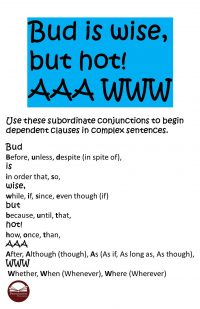
To improve writing, add adverbial clauses, which describe describe an adjective, an adverb, or verb. A subordinating conjunction always introduces an adverbial clause. The subordinating conjunction signals the relationship between the adverbial clause and the independent clause. Use a comma to set off an introductory adverbial clause, but not an adverbial clause that ends a sentence. Use this memory trick to remember the subordinating conjunctions:

Bud is wise, but hot! AAA WWW

before, unless, despite (in spite of), in order that, so, while, if, since, even though (if), because, until, that, how, once, than, after, although (though), as (as if, as long as, as though), whether, when (whenever), where (wherever)

Example: as long as she can wait

To improve writing, add noun clauses, which describe are used as a subject, a complement (the rest of the sentence besides the subject and predicate), or as the object of a preposition. Transitions beginning noun clauses include that, what, whatever, which, whichever, who, whoever, whom, and whomever.

Example: whatever he demands

*****

Syntax Programs

Pennington Publishing Grammar Programs

Teaching Grammar, Usage, and Mechanics (Grades 4, 5, 6, 7, 8, and High School) are full-year, traditional, grade-level grammar, usage, and mechanics programs with plenty of remedial practice to help students catch up while they keep up with grade-level standards. Twice-per-week, 30-minute, no prep lessons in print or interactive Google slides with a fun secret agent theme. Simple sentence diagrams, mentor texts, video lessons, sentence dictations. Plenty of practice in the writing context. Includes biweekly tests and a final exam.

Grammar, Usage, and Mechanics Interactive Notebook (Grades 4‒8) is a full-year, no prep interactive notebook without all the mess. Twice-per-week, 30-minute, no prep grammar, usage, and mechanics lessons, formatted in Cornell Notes with cartoon response, writing application, 3D graphic organizers (easy cut and paste foldables), and great resource links. No need to create a teacher INB for student make-up work—it’s done for you! Plus, get remedial worksheets, biweekly tests, and a final exam.

Syntax in Reading and Writing is a function-based, sentence-level syntax program, designed to build reading comprehension and increase writing sophistication. The 18 parts of speech, phrases, and clauses lessons are each leveled from basic (elementary) to advanced (middle and high school) and feature 5 lesson components (10–15 minutes each): 1. Learn It!  2. Identify It!  3. Explain It! (analysis of challenging sentences) 4. Revise It! (kernel sentences, sentence expansion, syntactic manipulation) 5. Create It! (Short writing application with the syntactic focus in different genre).

Get the Diagnostic Grammar, Usage, and Mechanics Assessments, Matrix, and Final Exam FREE Resource:

Grammar/Mechanics, Writing , , , , , , , ,

How to Identify Subjects and Predicates

How to Teach Complete Sentences

Writing in Complete Sentences

English-language arts teachers do spend a lot of time getting students to identify and use subjects and predicates properly. These are the two major parts of the sentence. In fact, every complete sentence must have a subject and predicate.

Today’s grammar and usage lesson is on subjects and predicates. Remember that every sentence must have a subject and predicate. It’s important to know how to identify subjects and predicates. Learning how to identify subjects and predicates will help students and employees comprehend sentences and avoid sentence fragments and run-ons in their writing. Knowing how to identify subjects and predicates will also allow students to manipulate sentences for greater sentence variety. For example, good writers strive to write 50% of their sentences without sentence subject openers. There are other ways to construct a sentence other than SUBJECT-PREDICATE-OBJECT.

Now let’s read the grammar and usage lesson (Common Core Language Standard 1.0) and study the examples.

The subject is the “do-er” of the sentence. It tells whom or what the sentence is about. The simple subject is the noun or pronoun that the verb acts upon. The complete subject includes additional words that describe the simple subject. The compound subject describes a subject with two or more nouns or pronouns. Examples: women, the older women, she and the older women

The predicate does the work of the “do-er” of the sentence. The predicate shows a physical or mental action or it describes a state of being. The simple predicate is the verb that acts upon the subject of the sentence. The complete predicate includes additional words that modify the predicate. The compound predicate describes a predicate with two or more verbs.

Examples: danced, had danced skillfully, danced and sang

How to Identify Subjects

The simple subject is usually found at the start of a declarative sentence. To find the subject of the sentence, first identify any prepositional phrases and eliminate the nouns and pronouns found in these phrases from consideration. The subject of the sentence is not part of a prepositional phrase. Frequently, in imperative sentences, the simple subject, “you,” is implied (suggested, not stated).

How to Identify Predicates

To find the predicate, first identify the subject and ask “What?” The answer to this question should be the predicate. The predicate usually follows the subject in a sentence. However, it can be placed before the subject in a question (Was it your mother’s purse?), in an implied (suggested, not stated) sentence (Look out!), or in a phrase or clause at the beginning of a sentence to add special emphasis (Even more interesting was the fact that she knew it would probably rain).

Practice the advice about with the following examples:

Simple Predicates

He thought of an idea. (thought)

She was a nice lady. (was)

An angry man tried to run me off the road. (tried)

Complete Predicate

He always thought of an idea. (always thought of an idea)

She was a nice lady. (was a nice lady)

An angry man tried to run me off the road. (tried to run me off the road)

Writing Application: Write your own sentence using a complete subject and a complete predicate.

*****

Syntax Programs

Pennington Publishing Grammar Programs

Teaching Grammar, Usage, and Mechanics (Grades 4, 5, 6, 7, 8, and High School) are full-year, traditional, grade-level grammar, usage, and mechanics programs with plenty of remedial practice to help students catch up while they keep up with grade-level standards. Twice-per-week, 30-minute, no prep lessons in print or interactive Google slides with a fun secret agent theme. Simple sentence diagrams, mentor texts, video lessons, sentence dictations. Plenty of practice in the writing context. Includes biweekly tests and a final exam.

Grammar, Usage, and Mechanics Interactive Notebook (Grades 4‒8) is a full-year, no prep interactive notebook without all the mess. Twice-per-week, 30-minute, no prep grammar, usage, and mechanics lessons, formatted in Cornell Notes with cartoon response, writing application, 3D graphic organizers (easy cut and paste foldables), and great resource links. No need to create a teacher INB for student make-up work—it’s done for you! Plus, get remedial worksheets, biweekly tests, and a final exam.

Syntax in Reading and Writing is a function-based, sentence-level syntax program, designed to build reading comprehension and increase writing sophistication. The 18 parts of speech, phrases, and clauses lessons are each leveled from basic (elementary) to advanced (middle and high school) and feature 5 lesson components (10–15 minutes each): 1. Learn It!  2. Identify It!  3. Explain It! (analysis of challenging sentences) 4. Revise It! (kernel sentences, sentence expansion, syntactic manipulation) 5. Create It! (Short writing application with the syntactic focus in different genre).

Get the Diagnostic Grammar, Usage, and Mechanics Assessments, Matrix, and Final Exam FREE Resource:

Get the “To Be” Verbs Posters FREE Resource:

Get the Grammar and Mechanics Grades 4-8 Instructional Scope and Sequence FREE Resource:

Grammar/Mechanics, Literacy Centers, Study Skills, Writing , , , , , , , , , ,

How to Fix Sentence Fragments

How to Teach Complete Sentences

Writing in Complete Sentences

Learning how to fix sentence fragments is challenging to writers of all levels. Inexperienced writers may write in sentence fragments because they do not understand what constitutes a complete thought or because they model their writing after their fragmented speech. Experienced writers get habituated to “memo-style,” dialogue (text messaging), or point-by point writing and struggle writing connected thoughts. Here are a few workable strategies to revise these errors in sentence structure. But first, let’s begin with what constitutes a complete sentence.

A Complete Sentence

  1. tells a complete thought.
  2. has both a subject and a predicate.
  3. has the voice drop down at the end of a statement and the voice go up at the end of a question (in English).

Sentence Fragments

Definition: A sentence fragment consists of  an incomplete thought, a sentence subject, or a sentence predicate and so is an incomplete sentence.

Sentence Fragment Examples:

After he went to work. (Incomplete Thought)

Going to school. (No Sentence Subject)

The young, attractive woman. (No Sentence Predicate)

The Three Types of Sentence Fragments and Their Fixes

1. After they ate dinner. (Incomplete Thought Starting with a Subordinating Conjunction)

The Fix

-Eliminate the subordinating conjunction.

Subordinating Conjunctions:

after, as, although, because, before, how, however, since, so, that, when, whenever, which, while, who, unless, until, when, whenever, whether, while

2. Running fast down the hall. (No Sentence Subject)

The Fix

-Add on a subject (person, place, thing, or idea), i.e. the “do-er” to act on the verb in the sentence. Change the verb form to fit with the subject.

3. Mainly, the passage of time. (No Sentence Predicate)

The Fix

-Add on a verb (physical or mental action or a state of being) to “do” the action of the “do-er,” i.e. the subject.

*****

Syntax Programs

Pennington Publishing Grammar Programs

Teaching Grammar, Usage, and Mechanics (Grades 4, 5, 6, 7, 8, and High School) are full-year, traditional, grade-level grammar, usage, and mechanics programs with plenty of remedial practice to help students catch up while they keep up with grade-level standards. Twice-per-week, 30-minute, no prep lessons in print or interactive Google slides with a fun secret agent theme. Simple sentence diagrams, mentor texts, video lessons, sentence dictations. Plenty of practice in the writing context. Includes biweekly tests and a final exam.

Grammar, Usage, and Mechanics Interactive Notebook (Grades 4‒8) is a full-year, no prep interactive notebook without all the mess. Twice-per-week, 30-minute, no prep grammar, usage, and mechanics lessons, formatted in Cornell Notes with cartoon response, writing application, 3D graphic organizers (easy cut and paste foldables), and great resource links. No need to create a teacher INB for student make-up work—it’s done for you! Plus, get remedial worksheets, biweekly tests, and a final exam.

Syntax in Reading and Writing is a function-based, sentence-level syntax program, designed to build reading comprehension and increase writing sophistication. The 18 parts of speech, phrases, and clauses lessons are each leveled from basic (elementary) to advanced (middle and high school) and feature 5 lesson components (10–15 minutes each): 1. Learn It!  2. Identify It!  3. Explain It! (analysis of challenging sentences) 4. Revise It! (kernel sentences, sentence expansion, syntactic manipulation) 5. Create It! (Short writing application with the syntactic focus in different genre).

Get the Diagnostic Grammar, Usage, and Mechanics Assessments, Matrix, and Final Exam FREE Resource:

Get the “To Be” Verbs Posters FREE Resource:

Get the Grammar and Mechanics Grades 4-8 Instructional Scope and Sequence FREE Resource:

Grammar/Mechanics, Literacy Centers, Study Skills, Writing , , , , , ,