Archive

Posts Tagged ‘Teaching the Language Strand’

Should We Teach Standards or Children?

As a teacher, I am reminded ad nauseam to “teach the Common Core State Standards.” Since I am a reading specialist, hiding inside the Trojan horse of English-language Arts in an underperforming middle school, I quietly administer reading, spelling, grammar, usage, and mechanics assessments to my students. It won’t come as much of a surprise to most of you that the diagnostic data indicate that some students have severe reading and spelling deficits.

Here then is the crux of the issue. The underlying pre-suppositions, results, and practice of standards-based instruction can be diametrically opposed to assessment-based instruction, according to the diagnostic needs of our children. This is especially true in the field of reading instruction.

The underlying pre-suppositions of the standards-based movement accept a priori that education is solely a behavioral science. We critics of this assumption would argue that much of teaching, learning, and parenting is culturally-bound and intuitive. In other words, some of effective teaching is truly an art form. We critics are not above using the scientific method and learning theory to debunk the behavioral purists. For example, the standards-based-movement begs the vital question regarding its linear scope and sequence of grade level standards: Do we really learn that way? Many teachers in my fields of English-language Arts and reading would argue the contrary. In fact, anyone who has taught the basic parts of speech to sophomores in high school won’t be surprised to learn that excellent teachers from elementary school-to middle school-to last year’s freshman class taught the same parts of speech. In other words, some learning may be recursive, not linear. Teachers, students, and parents are the critical variables here. The Common Core writers recognize this recursive element and have included the Progressive Skills Review within the Language Strand to address this instructional issue.

As is frequently the case in education, an idea takes on a life of its own in practice. A conversation a few years back with a fellow English teacher was instructive, but chilling. In discussing the results of our informal reading assessments, he looked over the clearly demonstrated reading deficits in his testing data and then said, “I teach the grade level standards. I’m not paid to go back and teach everything that the students don’t know.” He accepted a job as an administrator in our district the next year. Now, I am not over-critical of administrators… They are held accountable to implement standards-based instruction and to increase the all-important state and/or district standards-based test scores. However, administrators have got to do better than the principal who refused to implement reading intervention programs at her under-performing school because “The elementary teachers are supposed to teach reading; that’s their job, not ours. We teach the middle school Common Core State Standards here.” Of course, the principal certainly needs to read the appendices of the Common Core Standards which recognize the need for assessment-based instruction.

It’s easy to whine at the devolution of academic freedom and the sorry state of education that has been relegated to a series of standards-based grade level scope and sequence charts, with benchmarks or task analyses tacked on to provide the pretense of specificity. It’s harder to offer solutions, but here are a few thoughts.

True educators need to teach both Standards and children.

1. Do teach the grade level Common Core State Standards. Really. However, control the time allotted to teaching these standards and insist on your academic freedom here. When challenged as to why you are teaching a lesson or skill that is not explicitly listed as a grade level Standard, cite previous or advanced grade level standards that address your remedial or advanced grade level instruction.

2. Patiently argue that some students need to “catch up, to keep up.” Justify concurrent remediation or acceleration and grade level instruction by citing diagnostic data. Let data plead your case. For example, if instructed not to teach to diagnosed deficits, ask the principal/district supervisor to write a letter to the parents of students to alleviate you of this responsibility, against your informed judgment. They won’t, but they won’t bother you for awhile.

3. Explain that that any criticism is not about really about what you teach, but rather about how you teach. You are scaffolding instruction, according to the demonstrated diagnostic needs of your students in order to teach the grade level standards. That’s why assessment-based instruction is so critical. You are making the standards comprehensible and in order to do so, you must differentiate instruction. How you teach is a matter of academic freedom.

*****
Teaching Grammar and Mechanics for Grades 4-High School

Teaching Grammar and Mechanics Grades 4, 5, 6, 7, 8, and High School Programs

I’m Mark Pennington, author of the full-year interactive grammar notebooks and the traditional grade-level 4, 5, 6, 7, 8 and high school Teaching Grammar and Mechanics programs. Teaching Grammar and Mechanics includes 56 (64 for high school) interactive language conventions lessons,  designed for twice-per-week direct instruction in the grade-level grammar, usage, and mechanics standards. The scripted lessons (perfect for the grammatically-challenged teacher) are formatted for classroom display. Standards review, definitions and examples, practice and error analysis, simple sentence diagrams, mentor texts with writing applications, and formative assessments are woven into every 25-minute lesson. The program also includes the Diagnostic Grammar, Usage, and Mechanics Assessments with corresponding worksheets to help students catch up, while they keep up with grade-level, standards-aligned instruction.

Grammar/Mechanics, Reading, Writing , , , , , , , , , , , , , , , , , ,

Ten Tips to Improving Writing Coherency

Using Coherence and Word Choice e-Comments

Coherence and Word Choice e-Comments

Ten Tips to Improving Writing Coherency

Writing coherency refers to how well sentences and paragraphs are organized into an understandable whole. Good writing coherency is reader-centered. From the reader’s point of view, the train of thought must be connected, easy to follow, and make sense. Incoherent writing is inconsiderate to the reader. If the writing lacks coherency, the reader’s comprehension and enjoyment of that writing will decrease. A reader may have to re-read, be forced to use too many context clues to understand what is being said, or make an undue amount of inferences.

To improve coherency, writers need to ensure that their writing has these characteristics:

1. Predictable Paragraph Organization To maintain optimal coherency, organize paragraphs in the way that readers are accustomed. For example, unless there is a compelling reason to do otherwise, place the topic sentence in the first position of the paragraph. The topic sentence appears in the first position of the paragraph 80% of the time in expository writing. Because of this high percentage, readers expect the main idea of the paragraph to be in this position. Similarly, the thesis statement appears 50% of the time as the last sentence in an essay introduction, so follow this practice as well.

Additionally, the Ancient Greeks developed the rhetorical rules for our writing, and these rules dictate that the most important idea in any communication needs to be stated first. Organize paragraphs with customary and traditional structures to be considerate to your reader.

2. Comprehensible Sentence Structure- Again, toe the line with those Ancient Greeks. English follows suit by placing the most important words at the beginning of the sentence. In the sentence: “You need to mail that letter today,” the emphasis is on the action. In the sentence: “Today, you need to mail that letter,” the emphasis is on the time. English grammar is very flexible in its forms and so can emphasize words with many different grammatical constructions. See How to Improve Sentence Variety with Grammatical Sentence Openers for examples.

Vary the length of sentences. Charles Dickens can be difficult to read because of his notoriously long-winded sentences. A good rule of thumb is to never place two long sentences next to each other. Of course, short staccato sentences can get irritating, as well. Strive for balance in sentence length to increase reader understanding and concentration.

3. Repetition- Repeat key words, phrases, or clauses to build coherency. Martin Luther King, Jr. used the “I have a dream” clause nine different times in his short speech. Also, write with parallel grammatical structures such as in Abraham Lincoln’s “conceived in liberty, and dedicated to the proposition that all men are created equal.” Notice the repeated “_ed” past participles, each followed by prepositional phrases.

4. Effective Sentence Transitions- Use, but don’t over use, transition words and phrases at the beginnings of sentences to connect to previous thoughts. Remember that most transitions at the beginning of sentences are followed by a comma, except in  short sentences. A helpful list follows.

The author’s TEACHING ESSAYS BUNDLE provides 11 Transition Worksheets, one for each purpose. Each worksheet requires students to identify, select, and apply the transition words in the context of sentences and paragraphs. Great practice! Check out the free samples below.

Get the Transition Worksheets FREE Resource:

5. Clear Pronouns- A pronoun takes the place of a proper (named) or common (unnamed) noun. Using clear pronoun references will improve reader understanding of your writing. Always place pronoun references close to the nouns which they represent. If in doubt, simply repeat the noun. For example, in the sentence: “The dog traveled over the hill, chased a bunny, drank from a stream, terrorized a stray cat, and than it returned home,” the it pronoun does not clearly describe the antecedent dog. The sentence would be more coherent as “The dog enjoyed many adventures before it returned home: traveling over a hill, chasing a bunny, drinking from a stream, and terrorizing a cat.”

6. Clear Modifiers- A modifier is a word, phrase, or clause that acts as an adjective or adverb to define or limit the meaning of another word or phrase. For example, in the sentence: “Thrown in the air, the dog fetched the Frisbee®,” the phrase “Thrown in the air” is a classic dangling modifier. The reader may be confused into thinking that the dog, not the disc, was the one thrown into the air. To prevent dangling modifiers, always place modifiers close to the nouns or verbs that they intend to modify. The above sentence would better be written as “Thrown in the air, the Frisbee® was fetched by the dog” (albeit in passive voice).

7. Precise Word Choice Use specific, rather than vague, meaningless words. For example, instead of “Many things caused the recession,” replace with “Decreasing consumer confidence and high gas prices caused the recession.” Use words that fit your audience. Avoid technical or academic language when simple words will suffice, unless your readers are well-acquainted with the terminology. Be courteous to your reader and define unfamiliar words to improve coherence.

8. Appropriate Conjunctions- The common coordinating conjunctions: for, and, nor, but, or, yet, and so (F.A.N.B.O.Y.S.) each have precise meanings and need to be used correctly to maintain coherency. For example, the sentence: “He needed money for paying expenses,” does not correctly use the conjunction for. The sentence suggests that money is the medium of exchange for paying expenses, rather than a necessary prerequisite for paying expenses. Using the conjunction so would create better sentence coherency as in “He needed money so he could pay expenses.”

9. Limited Passive Voice- In passive voice, the subject receives the action with the use of a passive verb. A passive verb combines a “to-be” verb with a past participle (_d, _ed, or _en ending). For example, is practiced, was doubted, had been eaten. Instead, use the active voice in which the subject does the action. For example, “John ran to the post office.” Passive voice can be used intentionally to emphasize objectivity, such as in “It has been shown in educational research that more women than men….” Otherwise, avoid the passive voice.

10. Brevity- Using concise language builds reader understanding. Readers lose focus, if the writing is verbose. Rather than “It would certainly be very nice if you would please consider it in your heart to take out the trash,” replace with the simple and to the point “Please take out the trash.”

Following are examples of an incoherent paragraph and a coherent revision of that same paragraph. Try revising the incoherent model, using the Ten Tips to Improve Writing Coherency before looking at the revision to see if you can apply these tips.

Incoherent Writing Model

Snow creates problems. Streets need shoveling. Snowplows cannot always access streets. Driveways are hard to clear. Many communities leave the expense of clearing snow up to the homeowner. Building up dangerously high on a roof, it can break roof framing. Snow may seem harmless. It can damage houses. Snow is always potentially hazardous. It can endanger people.

Coherent Revision

Snow creates two problems for homeowners. First, it requires shoveling to keep driveways and streets clear, but snowplows cannot always access them. Furthermore, many communities leave the expense of clearing snow up to the homeowner; thus some homeowners cannot afford the expense of hiring a snowplow. Second, snow may seem harmless, yet it is not. Snow can build up dangerously high on a roof and break roof framing. Always potentially hazardous, snow can damage houses and endanger those who live in them.

Also, check out Mark Pennington’s articles on writing unity and parallelism.

*****

Teaching Essays

TEACHING ESSAYS BUNDLE

The author’s TEACHING ESSAYS BUNDLE includes the three printable and digital resources students need to master the CCSS W.1 argumentative and W.2 informational/explanatory essays. Each no-prep resource allows students to work at their own paces via mastery learning. How to Teach Essays includes 42 skill-based essay strategy worksheets (fillable PDFs and 62 Google slides), beginning with simple 3-word paragraphs and proceeding step-by-step to complex multi-paragraph essays. One skill builds upon another. The Essay Skills Worksheets include 97 worksheets (printables and 97 Google slides) to help teachers differentiate writing instruction with both remedial and advanced writing skills. The Eight Writing Process Essays (printables and 170 Google slides) each feature an on-demand diagnostic essay assessment, writing prompt with connected reading, brainstorming, graphic organizer, response, revision, and editing activities. Plus, each essay includes a detailed analytical (not holistic) rubric for assessment-based learning.

Grammar/Mechanics, Literacy Centers, Study Skills, Writing , , , , , , , , , , ,

How to Eliminate “To Be” Verbs in Writing

Every English teacher has a sure-fire revision tip that makes developing writers dig down deep and revise initial drafts. One of my favorites involves reducing the number of “to be verbs”: is, am, are, was, were, be, being, and been.

At this point, even before I begin to plead my case, I hear the grumbling of the contrarians. One of them mutters a snide, rhetorical question: Didn’t Shakespeare say “To be, or not to be: that is the question:”? He used three “to be” verbs right there! If it’s good enough for Shakespeare, it’s good enough for me. True, but Will used only six more “to be” verbs in Hamlet’s next 34 lines. My goals are to convince teachers to help their students reduce, not eliminate the “to be” verbs, and so write with greater precision and purpose. There. I just used a “to be” verb. Feeling better?

Eliminate To Be Verbs

Eliminate “To Be” Verbs

What’s So Wrong with “To Be” Verbs?

  1. The “to be” verbs: is, am, are, was, were, be, being, been are state of being verbs, which means that they unduly claim a degree of permanence. For example, “I am hungry.” For most Americans, hunger is only a temporary condition.
  2. The “to be” verbs claim absolute truth and exclude other views. “Classical music is very sophisticated.” Few would agree that all classical compositions are always sophisticated.
  3. The “to be” verbs are general and lack specificity. A mother may tell her child, “Be good at school today.” The more specific “Don’t talk when the teacher talks today” would probably work better.
  4. The “to be” verbs are vague. For example, “That school is great.” Clarify the sentence as “That school has wonderful teachers, terrific students, and supportive parents.”
  5. The “to be” verbs often confuse the reader about the subject of the sentence. For example, “It was nice of you to visit.” Who or what is the “It?”

Adapted from Ken Ward’s E-Prime article at http://www.trans4mind.com/personal_development/GeneralSemantics/KensEPrime.htm

When Can We Use “To Be” Verbs?

It’s not that “to be” verbs are always bad; sometimes writers must use “to be” verbs to communicate exactly what the writer wants to say. In fact, these verb forms can be difficult to replace. When the verb links to the subject (the do-er) of the sentence as a state of being, it performs one of these five functions:

  1. Exists−Is there any trouble? Yes, I am he (predicate nominative).
  2. Happens−The meetings are over.
  3. Locates−He was at the birthday party.
  4. Identifies−Those children were friendly (predicate adjective).
  5. Describes−That could be scary (helping verb)! He is being helpful (progressive tense). Those girls have been so mean (perfect tense).

Generally, writers should minimize the use of “to be” verbs in essays. “To be” verbs should appear more frequently in narrative writing, especially in dialogue. Authentic-sounding dialogue mimics our informal speech, which often uses the “to be” verbs.

However, when writers can replace a “to be” verb with a vivid, “show me” verb in any writing genre, it certainly makes sense to do so. With a good “show me” verb, the reader (or listener) can picture the physical or mental action of the verb. The verb engages the interest of the reader and specifically communicates the nature of the action. But, not all non-“to be” verbs are vivid, “show me” verbs. For example, the physical and mental action verbs in this sentence do not use vivid, “show me” verbs: The boy sits down on the bench and thinks what to do next. In contrast, the physical and mental action verbs in this sentence do use vivid, “show me” verbs: The boy slouches down on the bench and studies what to do next.

So, how can we get our students to reduce or eliminate “to be” verbs in their essays to create precision of meaning, specificity, clarity, and just good old sentence variety? How do we get our students to use these vivid “show me” verbs instead? Try these five strategies:

How to Eliminate “To Be” Verbs

Eliminate “To Be” Verbs

How to Eliminate “To Be” Verbs

  1. IdentifyStudents need to memorize the “to be” verbs to avoid using them and to revise those that they have used in essays: is, am, are, was, were, be, being, been. Teach students to self-edit by circling “to be” verbs in the revision stage of writing. Teach students how to problem-solve whether a “to be” verb is necessary or not. Teach students to identify and revise Non-standard English forms of the “to be” verb (Common Core State Standards L.2,3). For example, “They be watching cartoons” or “She been taking her time” You can also identify, explain, and suggest revisions of both “to be” verbs and nonstandard English with one click from my e-Comments app.
  2. SubstituteSometimes a good replacement of a “to be” verb just pops into the brain. For example, instead of “That cherry pie is delicious,” substitute the “to be” verb is with tastes as in “That cherry pie tastes delicious.” If a strong, vivid verb does not pop into the brain, HERE is a great list of action verbs, specifically designed for persuasive/argumentative essays, informational/explanatory essays, literary analysis, and narratives (W1.0, 2.0, 3.0 of the Common Core Writing Standards) with useful categories for your students. Thanks to Mary Beth Foster, University of Arizona Strategic Alternative Learning Techniques (SALT) Center for compiling this list. Also, substitute the “there,” “here,” and “it” + “to be” verbs. For example, instead of “There is the cake, and here are the pies for dessert, and it is served by Mom,” replace with “Mom serves the cake and pies for dessert.” Let’s also add on the “this,” “that,” “these,” and “those” + “to be” verbs. Finally, strong linking verbs can replace “to be” verbs. For example, instead of “That was still the best choice,” substitute the “to be” verb was with the linking verb remained as in “That remained the best choice.”
  3. ConvertStudents can start  the sentence differently to see if this helps eliminate a “to be” verb. For example, instead of “Charles Schulz was the creator of the Peanuts cartoon strip,” convert the common noun creator to the verb created as in “Charles Schulz created the Peanuts cartoon strip.” 
  4. Change−To eliminate a “to be” verb, students can change the subject of the sentence to another noun or pronoun found in the sentence and rearrange the order of the sentence. For example, instead of “The car was stopped by a police officer,” change the complete subject, the car, to a police officer to write “A police officer stopped the car.” Also, students can add in a different sentence subject to eliminate a “to be” verb. For example, instead of “The books were written in Latin,” add in a different sentence subject, such as “authors” to change the passive voice to the active voice and write “Authors wrote the books in Latin. Lastly, starting the sentence with a different word or part of speech will help eliminate the “to be” verb. For example, instead of “The monster was in the dark tunnel creeping,” rearrange as “Down the dark tunnel crept the monster.”
  5. CombineLook at the sentences before and after the one with the “to be” verb to see if combining the sentences will eliminate the “to be” verb. For example, instead of “The child was sad. The sensitive child was feeling that way because of the news story,” combine as “The news story saddened the sensitive child.”

A Teaching Plan to Eliminate the “To Be” Verb

  1. Post a list of the “to be” verbs and the problem-solving strategies listed above for student reference. Download the three “To Be” Posters at the end of this article. Great tools to teach!
  2. Why not create a Dead Verbs Cemetery bulletin board? (What a great idea for Halloween!)
  3. Share the five strategies one at a time, so as not to overwhelm students. Teach, practice, and master only one strategy  before moving on to another strategy.
  4. Use teacher think-alouds to model the “to be” verb revision process.
  5. Then, turn the revision chore on over to the whole class with one student writing sample. Correct whole class and commend the variety of effective revisions. Compare sentence revisions and discuss which strategies worked and did not work to eliminate the “to be” verbs.
  6. Next, collect student writing samples from the whole class and have students individually revise their peers’ “to be” verbs. Peer editing focused on one target issue makes sense.
  7. Next, have students revise their own sentences from their own writing samples, using the five strategies.

After teaching and practicing all five strategies, set the “rule” that from now on only one “to-be” verb is allowed in any paragraph (excluding direct quotes). Use peer editing to help identify the “to-be” verbs and peer tutors to help struggling students.

Teaching the strategies and practicing them in the context of student writing samples will help students recognize and avoid these “writing crutches” in their own writing. The end result? More precise and purposeful student writing with vivid, “show me” verbs.

Check out the quality program materials found in these teacher-created and classroom-tested resources:

*****

Syntax Programs

Pennington Publishing Grammar Programs

Teaching Grammar, Usage, and Mechanics (Grades 4, 5, 6, 7, 8, and High School) are full-year, traditional, grade-level grammar, usage, and mechanics programs with plenty of remedial practice to help students catch up while they keep up with grade-level standards. Twice-per-week, 30-minute, no prep lessons in print or interactive Google slides with a fun secret agent theme. Simple sentence diagrams, mentor texts, video lessons, sentence dictations. Plenty of practice in the writing context. Includes biweekly tests and a final exam.

Grammar, Usage, and Mechanics Interactive Notebook (Grades 4‒8) is a full-year, no prep interactive notebook without all the mess. Twice-per-week, 30-minute, no prep grammar, usage, and mechanics lessons, formatted in Cornell Notes with cartoon response, writing application, 3D graphic organizers (easy cut and paste foldables), and great resource links. No need to create a teacher INB for student make-up work—it’s done for you! Plus, get remedial worksheets, biweekly tests, and a final exam.

Syntax in Reading and Writing is a function-based, sentence-level syntax program, designed to build reading comprehension and increase writing sophistication. The 18 parts of speech, phrases, and clauses lessons are each leveled from basic (elementary) to advanced (middle and high school) and feature 5 lesson components (10–15 minutes each): 1. Learn It!  2. Identify It!  3. Explain It! (analysis of challenging sentences) 4. Revise It! (kernel sentences, sentence expansion, syntactic manipulation) 5. Create It! (Short writing application with the syntactic focus in different genre).

Get the Diagnostic Grammar, Usage, and Mechanics Assessments, Matrix, and Final Exam FREE Resource:

Get the Eliminate To Be Verbs Poster and Worksheets FREE Resource:

Grammar/Mechanics, Literacy Centers, Study Skills, Writing , , , , , , , , , , , , , , , , , , ,

How to Grade Literary Discussions

Graded Literary Discussions

How to Grade Literary Discussions

The longer I teach, the more I become a capitalist in my ELA classroom. Although I would love to have students participate in rich literary discussions out of their love for reading and passion for truth, it’s a rare student who speaks up out of such pure motives. Over the years, I admit it. I have succumbed to incentives and with good results. Life is compromise.

Students need to know that their participation in class discussion is an important part of their overall grade. Otherwise, many will avoid participation or perceive the group discussion as being of minimal importance. In the school setting, rewards such as grades, extra credit, treats, stickers, privileges are all weapons which the creative teacher can employ to motivate class participation in discussions. Short term, explicit rewards tend to work better than long term ones.

Here is how I organize a graded literary discussion. I select a student to record the points that classmates will earn. The recorder writes tally marks for positive discussion contributions on my class seating chart. The recorder gets two points for this task, but he or she gives up the opportunity to participate in the discussion. I have no problems finding student recorders for this task.  Having a student recorder frees me up to lead the discussion without worrying about properly crediting responses. After a correct student response, I signal the recorder with my index finger and the recorder places a tally mark next to the name of the student. If the response is particularly insightful or directly responds to the response of another student, I may signal two fingers, for two tally marks. The latter must, of course, be accompanied by a resonating class “oooh!”

A good feature of this graded discussion technique is that it tracks student responses. During class discussion, I can survey the tally marks to determine who is failing to contribute or who is contributing excessively. I let students know that I will call on them, whether they raise their hands or not. I can also ensure that I am “calling on” male and female, ethnic sub-groups, etc. fairly. For the next graded class discussion, I have the recorder use a different color pen to differentiate the separate discussion grades.

Students perceive graded discussions as being fair and objective. Try announcing that the class will have a graded literary discussions the next day and students might just “cheat” by reading the assigned text and anticipating/preparing for your questions at home. What a shame! Of course, you could provide your discussion questions in advance and level them according to Costa’s Levels of Questioning, Depth of Knowledge, or Bloom’s Taxonomy, but the students might wind up teaching themselves. What a shame!

But, how can a teacher design a group discussion and lead the discussion to help students help themselves learn? Check out How to Lead Effective Group Discussions.

*****

Intervention Program Science of Reading

The Science of Reading Intervention Program

The Science of Reading Intervention Program: Word Recognition includes explicit, scripted instruction and practice with the 5 Daily Google Slide Activities every reading intervention student needs: 1. Phonemic Awareness and Morphology 2. Blending, Segmenting, and Spelling 3. Sounds and Spellings (including handwriting) 4. Heart Words Practice 5. Sam and Friends Phonics Books (decodables). Plus, digital and printable sound wall cards and speech articulation songs. Print versions are available for all activities. First Half of the Year Program (55 minutes-per-day, 18 weeks)

The Science of Reading Intervention Program: Language Comprehension resources are designed for students who have completed the word recognition program or have demonstrated basic mastery of the alphabetic code and can read with some degree of fluency. The program features the 5 Weekly Language Comprehension Activities: 1. Background Knowledge Mentor Texts 2. Academic Language, Greek and Latin Morphology, Figures of Speech, Connotations, Multiple Meaning Words 3. Syntax in Reading 4. Reading Comprehension Strategies 5. Literacy Knowledge (Narrative and Expository). Second Half of the Year Program (30 minutes-per-day, 18 weeks)

The Science of Reading Intervention Program: Assessment-based Instruction provides diagnostically-based “second chance” instructional resources. The program includes 13 comprehensive assessments and matching instructional resources to fill in the yet-to-be-mastered gaps in phonemic awareness, alphabetic awareness, phonics, fluency (with YouTube modeled readings), Heart Words and Phonics Games, spelling patterns, grammar, usage, and mechanics, syllabication and morphology, executive function shills. Second Half of the Year Program (25 minutes-per-day, 18 weeks)

The Science of Reading Intervention Program BUNDLE  includes all 3 program components for the comprehensive, state-of-the-art (and science) grades 4-adult full-year program. Scripted, easy-to-teach, no prep, no need for time-consuming (albeit valuable) LETRS training or O-G certification… Learn as you teach and get results NOW for your students. Print to speech with plenty of speech to print instructional components.

SCIENCE OF READING INTERVENTION PROGRAM RESOURCES HERE for detailed product description and sample lessons.

Literacy Centers, Reading, Study Skills , , , , , , , , , ,

Why English Spelling Is So Difficult

Brief History of the English Language

Brief English Language History

President Andrew Jackson once remarked, “It’s a d____ poor mind that can think of only one way to spell a word!” Many Americans would readily agree. In fact, the English language is notorious for its spelling irregularities. Looking at the glass as being half-empty, it is true that only about half of our spellings exactly match their sounds.

What a crazy system, in which the word fish could be spelled as “ghoti.” That’s /f/ spelled “gh” as in rough, /i/ spelled “o” as in women, and /sh/ spelled /ti/ as in nation. Or how about the fact that the “ur” sound /ur/ can be spelled differently five times in one sentence? Her nurse first works early. Or how about the fact that the “sh” sound /sh/ can be spelled in 14 different ways? shine, sugar, ocean, tissue, ration, fuchsia, shist, pshaw, spacious, nauseous, anxious, conscious, chaperone, mansion.

However, looking at the glass as being half-full, the fact that 50% of the spellings exactly match their sounds certainly provides a helpful foundation upon which to build good spelling. We don’t have to memorize every word individually. Upon this 50% foundation, an additional 30% of spellings which conform to about eight of the most useful spelling rules can be added. This leaves about 20% of the words that must be memorized. We call these “Outlaw Words” for good reason. Jessie James couldn’t even spell his own name!

Additionally, our vocabulary is an amalgam of linguistic and historical influences. Over 50% of our academic words are built on ancient Greek and Latin word parts. French and Spanish add to our spelling lexicon as well. So, by studying languages we also improve our English spelling. If fact, spelling and vocabulary have a reciprocal relationship-spelling influences vocabulary and, conversely, vocabulary influences spelling.

So, given that our English spelling system is not simplistic, what should we do?

Diagnostic Literacy Assessments

Diagnostic Reading and Spelling Assessments

1.      Master the 50% foundation. The common sound spellings are very consistent. A wonderful multiple choice assessment of these patterns can be downloaded free at .

2.      Learn the eight conventional spelling rules that will add on another 30% of the spelling words that would be otherwise irregular.

3.      Memorize the common Outlaw Words. Many of these are our most frequently used words.  Make up memory tricks such as “you would rather have more dessert than a desert” or the “principal is my pal” for difficult words that do not follow the spelling patterns or conventional spelling rules.

4.      Memorize the most frequently misspelled words and commonly confused words.

5.      Memorize homophones: words that sound the same, but are spelled differently.

6.      Study the etymological (how the word was formed in its historical context) connections from Old and Middle English.

7.      Study the derivational spellings from other languages. Example: colonel from the French

A Model Grades 3-8 Spelling Scope and Sequence

Differentiated Spelling Instruction Grades 4-8

Differentiated Spelling Instruction

Preview the Grades 3-8 Spelling Scope and Sequence tied to the author’s comprehensive grades 3-8 Language Strand programs. The instructional scope and sequence includes grammar, usage, mechanics, spelling, and vocabulary. Teachers and district personnel are authorized to print and share this planning tool, with proper credit and/or citation. Why reinvent the wheel? Also check out my articles on Grammar Scope and Sequence, Mechanics Scope and Sequence, and Vocabulary Scope and Sequence.

FREE DOWNLOAD TO ASSESS THE QUALITY OF PENNINGTON PUBLISHING AMERICAN ENGLISH AND CANADIAN ENGLISH SPELLING PROGRAMS. Check out these grades 3-8 programs HERE. Administer my FREE comprehensive Diagnostic Spelling Assessment with audio file and recording matrix. It has 102 words (I did say comprehensive) and covers all common spelling patterns and conventional spelling rules. It only takes 22 minutes and includes an audio file with test administration instructions. Once you see the gaps in your students’ spelling patterns, you’re going to want to fill those gaps.

Get the Diagnostic Spelling Assessment, Mastery Matrix, and Sample Lessons FREE Resource:


Reading, Spelling/Vocabulary, Study Skills , , , , , , , , , , ,

Learn Vocabulary by Reading

Don’t read this article if you susceptible to thin-skin teacher disease. The typical vocabulary instruction in many classrooms includes passing out a “big words” list of 20 vocabulary terms on Monday and quizzing on this list on Friday. Starting to cringe? And now the buts start to formulate.

But half of those words on my list are from the literature selections this week.

But half of the words on my list are SAT®/ACT/academic language words.

But half of the words on my list are grade-level words that my students should know.

Other buts will focus on the learning process:

But I make them write out each word ten times.

But I make them create flashcards for each word.

But I use a crossword generator and have them do a crossword.

But I use a word jumble generator and have them do a word jumble.

But I have them underline the prefixes and suffixes and circle the roots.

Learning Vocabulary through Reading

Building Vocabulary through Reading

If some of us are truly honest about why we really teach what and how we teach, we might confess, “That’s what and how I learned, and I turned out okay.”

The problem with the typical vocabulary instructional practice described above is not necessarily the selection of the words, themselves, nor the teaching approach. Indeed, the problem is one of effectiveness. According to research, “Rote memorization of words and definitions is the least effective instructional method resulting in little long-term effect (Kameenui, Dixon, Carine 1987).”

Also, the problem of teaching vocabulary as described above is one of efficiency. Let’s do the math.

If students remember all 20 words, each week for the entire school year, they will have mastered 600 words. Now, realistically, if teachers got students to remember half of those words by the end of the year, most would be pleased. That leaves 300 words mastered per school year.

But, the American lexicon is over 800,000 words, and the SAT® word bank is over 30,000 words. Students need to learn 3,000 new words per year just to make one grade level reading progress (Honig 1983). Learning 300 words per year is a very small drop in a very big bucket. So, not only is rote word memorization ineffective, it is also inefficient.

For thick-skinned teachers who have made it to this point in the article, there is hope. Students can master the 3,000 new words (or more) this year that reading experts agree are necessary to achieve one-year-growth in reading levels. How? Through independent reading. 

If students read challenging text (with about 5%) unknown Tier 2 words, 30 minutes per day, four days per week, they will be exposed to 30,000 new words during the school year. Assuming that students will master the meanings of about 10% of those words through context clues, they will meet the 3,000 new words goal. But, we can do better. By teaching students to use context clues more effectively, we can confidently up that level of contextual mastery during independent reading to 15 or 20%.

Grades 4-8 Comprehensive Vocabulary

Comprehensive Vocabulary

At this point, some some teachers might be tempted to follow former sixth grade teacher Donalyn Miller’s advice (The Book Whisperer) and allocate that 30 minutes of class time per day (or more) to independent reading. Perhaps vocabulary acquisition really is a natural process that is caught, not taught (Steven Krashen). Rather than teach, teachers should simply facilitate vocabulary acquisition by providing plenty of engaging books in their classrooms and time each day for sustained silent reading and rich literacy discussions.

Not so fast. I would encourage teachers not to give into that temptation. We still need to earn our paychecks. We can use homework for that independent reading time and save valuable class time for instruction. As a former principal of mine once said, “We’re not paying you the big teacher bucks to babysit students while they read.”

But let’s remember that most independent reading consists of Tier 1 words. We do need explicit vocabulary instruction to make a dent in those Tier 2 words which constitute the bulk of our academic language.

*****

For full-year vocabulary programs which include multiple meaning words (L.4.a.), Greek and Latin morphology with Morphology Walls (L.4.a.), figures of speech (L.5.a.), words with special relationships (L.5.b.), words with connotative meanings (L.5.c.), and academic language words (L.6.0), check out the assessment-based grades 4, 5, 6, 7, and 8 Comprehensive Vocabulary.

Get the Context Clue Strategies FREE Resource:

Get the Grades 4,5,6,7,8 Vocabulary Sequence of Instruction FREE Resource:

Get the Greek and Latin Morphology Walls FREE Resource:

Get the Diagnostic Academic Language Assessment FREE Resource:

Literacy Centers, Reading, Spelling/Vocabulary, Study Skills, Writing , , , , , , , , , , , , , , , , ,

The Consonant-Final e Spelling Rule

The silent final at the end of a syllable is a holdover from Middle English. It sometimes serves three purposes.

  1. For one, it usually indicates that the preceding vowel will be a long sound if a single consonant, but not a double consonant, is placed between the vowel and the e. Examples: stove, gazelle
  2. It also ends English words ending in and Examples: pave, argue
  3. Lastly, the final softens the preceding /c/ and /g/ sounds. Examples: nice, cage

    Silent Final e Phonics

    Silent Final e Sound-Spellings

Yes, there are plenty of exceptions which must be memorized. Most of the exceptions are high frequency words. In fact the top 100 non-phonetic words, in terms of frequency, include 8 of them: were, where, there, some, come, gone, sure, lose

However, the single syllable silent final words are not the spelling problem for most students. It’s the multi-syllabic words in which as suffix is added on the ending silent final e that creates the spelling challenges, so that’s what the following spelling rule addresses.

Final Silent e Spelling Rule

Final e Spelling Rule

The Final e Spelling Rule

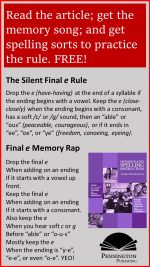
Drop the e (have-having) at the end of a syllable if the ending begins with a vowel. Keep the e (close-closely) when the ending begins with a consonant, has a soft /c/ or /g/ sound, then an “able” or “ous” (peaceable, courageous), or if it ends in “ee”, “oe”, or “ye” (freedom, canoeing, eyeing).

Exceptions to the rule: acknowledgment, acreage, argument, awful, duly, judgment, mileage, ninth, noticeable, outrageous, simply, truly, wisdom

Check out the Chant! The Final e Spelling Rule

Final e Memory Chant

Drop the final e

When adding on an ending

If it starts with a vowel up front.

Keep the final e

When adding on an ending

If it starts with a consonant.

Also keep the e

When you hear soft c or g

Before “able” or “o-u-s”

Mostly keep the e

When the ending is “y-e”,

“e-e”, or even “o-e”. YEO!

The Pennington Publishing Goldmine of Spelling Program FREEBIES

Want a concise list of all eight conventional spelling rules with corresponding songs? Click HERE.

Want a list of the 10 English Accent Rules to help you teach the conventional spelling rules? Click HERE.

Want a list of the 20 Advanced Syllable Rules to help you teach the conventional spelling rules? Click HERE.

Want the 104-word Diagnostic Spelling Assessment with audio file and recording matrix? Click HERE and download at the end of the article.

One great way to practice the rule is with worksheets targeted to the results of the Diagnostic Spelling Assessment. Download the FREE Double the Consonant Spelling Pattern Worksheets at the end of this article to help you check out the quality of Our Pennington Publishing spelling programs. Each worksheet sound-spelling example words, a spelling sort, rhymes or book searches, word jumbles, a short writing application, and a brief formative dictations assessment.

Why waste your time downloading each of these? Buy the grades 4, 5, 6, 7, or 8 Differentiated Spelling Instruction and get everything you need to have the best grade-level and remedial spelling program.

*****

Differentiated Spelling Instruction Grades 4-8

Differentiated Spelling Instruction

A Model Grades 3-8 Spelling Scope and Sequence

Preview the Grades 3-8 Spelling Scope and Sequence tied to the author’s comprehensive grades 3-8 Language Strand programs. The instructional scope and sequence includes grammar, usage, mechanics, spelling, and vocabulary. Teachers and district personnel are authorized to print and share this planning tool, with proper credit and/or citation. Why reinvent the wheel? Also check out my articles on Grammar Scope and Sequence, Mechanics Scope and Sequence, and Vocabulary Scope and Sequence.

FREE DOWNLOAD TO ASSESS THE QUALITY OF PENNINGTON PUBLISHING AMERICAN ENGLISH AND CANADIAN ENGLISH SPELLING PROGRAMS. Check out these grades 3-8 programs HERE. Administer my FREE comprehensive Diagnostic Spelling Assessment with audio file and recording matrix. It has 102 words (I did say comprehensive) and covers all common spelling patterns and conventional spelling rules. It only takes 22 minutes and includes an audio file with test administration instructions. Once you see the gaps in your students’ spelling patterns, you’re going to want to fill those gaps.

Get the Silent e Spelling Pattern Worksheets FREE Resource:

Grammar/Mechanics, Spelling/Vocabulary , , , , , , , , , , , , ,

The Final y Spelling Rule

Final y Spelling Rule

The Final y Spelling Rule

The Final Spelling Rule drives people crazy. I just typed in “final y spelling rule” into Google and 40,300,000 searches came back, so if you searched the same, you are not alone.

That final is one of the most adaptable letters. Of course you all remember that the vowels are a, e, i, o, and u…plus sometimes y. This “sometimes y” is true because, by definition, every English syllable has a vowel sound, and when follows a consonant at the end of a syllable or serves as the syllable itself, it produces the long /i/ vowel sound (when accented) or long /e/ vowel sound (when unaccented). Examples: by/pass, ba/by

Also, some words have in the middle of a syllable and it is pronounced as a short /i/ vowel sound. Examples: gym, mys/tic

However, the final spelling at the end of the syllable, when adding on a suffix, is the spelling that bothers most writers. When do you keep the and when do you drop it before adding on the suffix?

*****

The Final y Spelling Rule

Keep the y when adding an ending if the word ends in a vowel, then a y (delay-delayed), or if the ending begins with an i (copy-copying). Change the y to i when adding an ending if the word ends in a consonant, then a y (pretty-prettiest).

Exceptions to the rule: daily, dryly, dryness, paid, said, shyly, shyness, slyly, slyness

Check out the song! The Final y Spelling Rule

Hickory Dickory Y

The Clock Struck One

(to the tune of “Hickory Dickory Dock”)

If a root ends in a vowel,

Hickory, dickory dock,

And after that a y.

The mouse ran up the clock.

Just keep the y—and then said I,

The clock struck one—the mouse ran down,

“Add on the suffix to end.”

Hickory dickory dock.

But if a consonant then

Hickory, dickory dock,

A y should end a word,

The mouse ran up the clock.

Just change the y into an i

The clock struck two—the mouse ran down,

Except if the suffix has i.

Hickory dickory dock.

*****

A Model Grades 3-8 Spelling Scope and Sequence

Differentiated Spelling Instruction Grades 4-8

Differentiated Spelling Instruction

Preview the Grades 3-8 Spelling Scope and Sequence tied to the author’s comprehensive grades 3-8 Language Strand programs. The instructional scope and sequence includes grammar, usage, mechanics, spelling, and vocabulary. Teachers and district personnel are authorized to print and share this planning tool, with proper credit and/or citation. Why reinvent the wheel? Also check out my articles on Grammar Scope and Sequence, Mechanics Scope and Sequence, and Vocabulary Scope and Sequence.

FREE DOWNLOAD TO ASSESS THE QUALITY OF PENNINGTON PUBLISHING AMERICAN ENGLISH AND CANADIAN ENGLISH SPELLING PROGRAMS. Check out these grades 3-8 programs HERE. Administer my FREE comprehensive Diagnostic Spelling Assessment with audio file and recording matrix. It has 102 words (I did say comprehensive) and covers all common spelling patterns and conventional spelling rules. It only takes 22 minutes and includes an audio file with test administration instructions. Once you see the gaps in your students’ spelling patterns, you’re going to want to fill those gaps.

Get the The Final y Spelling Rule FREE Resource:

Grammar/Mechanics, Spelling/Vocabulary , , , , , , , , , , ,